Key takeaways
- A fully covered 3.5 m × 2.0 m fence panel carries about 2.5 kN mid-run and close to 5 kN at a free end in an 80 km/h gust.
- Mesh reduces the load but does not remove it. Its real gain is lower peaks at ends and corners and far less flutter.
- An unbraced dressed panel can start to tip at around 25 km/h. Every dressed run needs stays and added ballast.
- Specify by programme length and exposure: mesh at 270 to 340 gsm with outdoor-rated inks lasts 12 to 24 months on an open UAE site.
- Advertising on a construction fence in Dubai needs a permit under Decree No. 6 of 2020. The issuing authority depends on the plot.
Fence banners rarely fail at the print
When a fence banner comes down in the UAE, the print is almost never the cause. The eyelets tore, the ties snapped, or the fence went over with the banner still attached. Each of those is a structural problem that the artwork stage never considered.
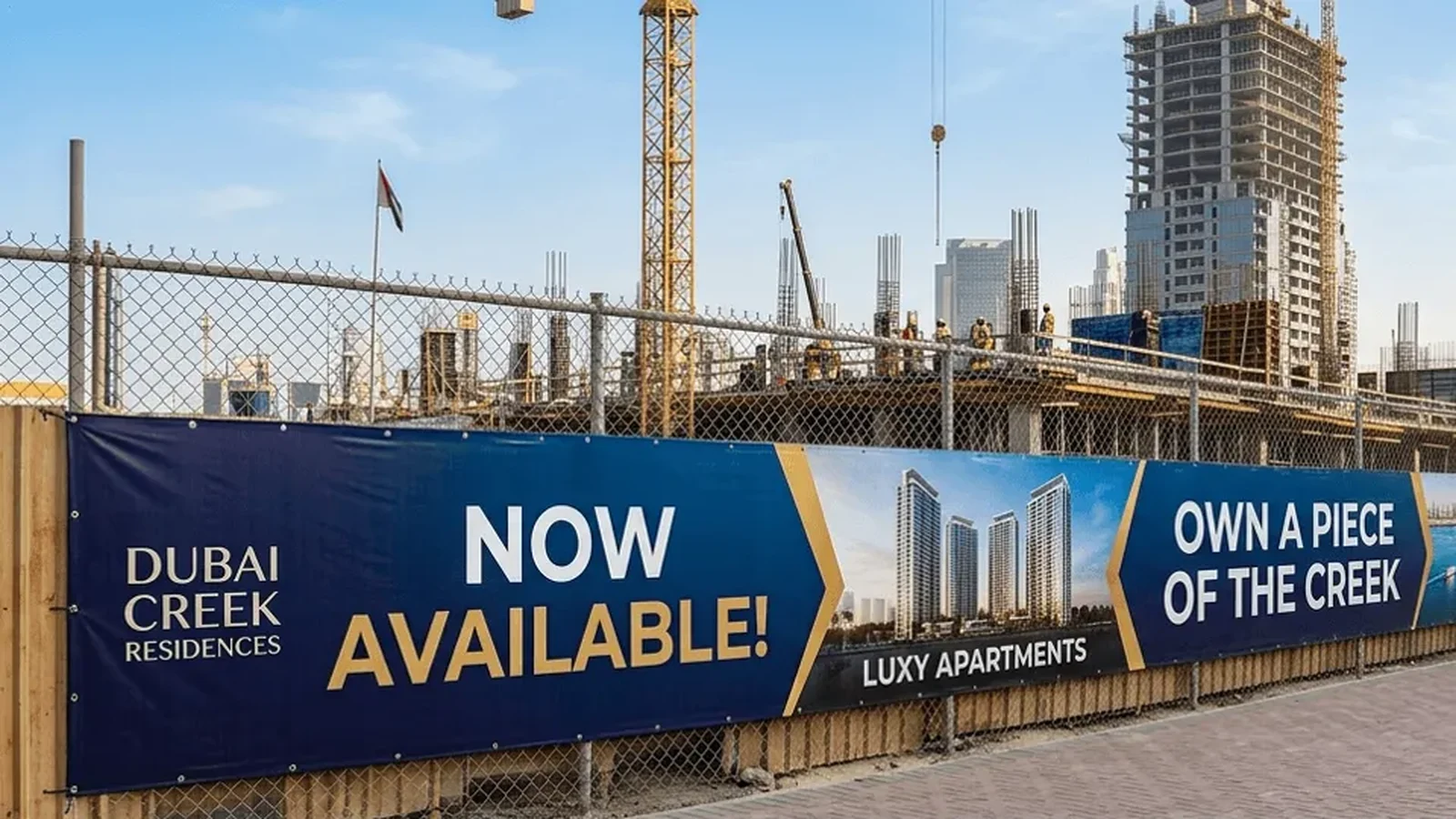
That matters because a dressed temporary fence is no longer just a fence. Once you cover it, you have built a free-standing wall that has to resist wind, on a base that was designed to stop people, not to hold a sail. On a road frontage in Dubai or Sharjah, a falling fence line is a public safety incident, not a signage defect.
This guide is written for site engineers, HSE managers, procurement teams, developers' marketing staff and signage contractors who specify, approve or install fence banners. It covers the load case, the honest limits of mesh, how to ballast and fix a dressed fence, print specs that survive Gulf conditions, artwork that reads at fence scale, and which authority approves what.
The load case: what wind actually does to a dressed panel
A fully covered fence panel at 80 km/h carries roughly 2.5 kN in the middle of a run and close to 5 kN at the end. Those are numbers worth knowing before anyone signs off a banner order.
UAE wind is not extreme by global standards, but it is persistent. Shamal events can hold 30 to 35 knots (55 to 65 km/h) near the surface for days, and the summer shamal peaks around midday, when sites are fully staffed. National Centre of Meteorology warnings of 55 to 65 km/h gusts are routine through winter and early summer.
The basic relationship is simple. Dynamic wind pressure is q = 0.613 × V², with V in m/s and q in pascals. The force on a panel is q × net pressure coefficient × area. For free-standing walls and hoardings, Eurocode EN 1991-1-4 uses a coefficient of about 1.2 along the middle of a long solid run. Near a free end it rises sharply, peaking around 3.4 in the first 0.3 × height. Averaged over a whole end panel, that works out at roughly 2.3, close to double the middle.
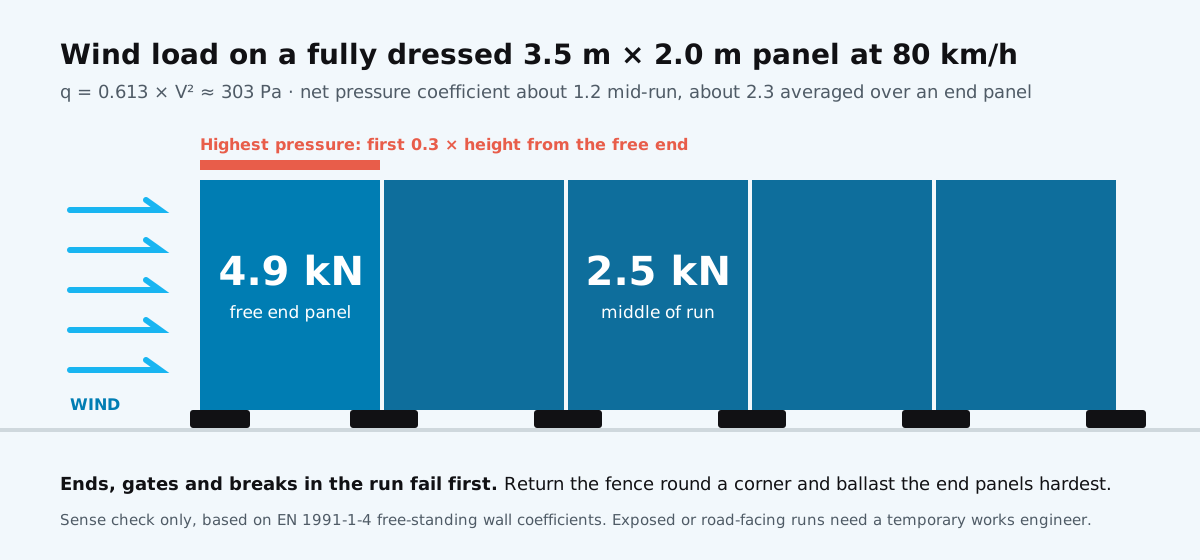
Worked example for a 3.5 m × 2.0 m panel (7 m²) fully covered with a solid banner, using gust speed directly and ignoring terrain and height factors:
| Gust speed | q (Pa) | Middle-of-run panel (kN) | End panel, no return (kN) |
|---|---|---|---|
| 60 km/h | 170 | 1.4 | 2.7 |
| 80 km/h | 303 | 2.5 | 4.9 |
| 100 km/h | 473 | 4.0 | 7.6 |
Three practical conclusions follow. First, the ends, gate openings and any break in the run are where fences fail, so they need the heaviest ballast and the closest fixings. Second, returning the fence round a corner, even by one panel, cuts the end-zone coefficient substantially. Third, these are loads on a standard temporary fence base. That base was never sized for them, which is the subject of the ballast section below.
These figures are a sense check, not a design. On road-facing runs, tall hoardings or exposed coastal plots, the fence and its dressing should be checked by the site's temporary works engineer.
Mesh vs solid: what porosity really buys you
Mesh is the right default for open fence lines, but it does not make the wind load go away. Treat it as a reduction, not an exemption.
Standard mesh banner has an open area of roughly 30 to 37 percent. Sales literature tends to imply that the wind simply passes through. The aerodynamics are less generous. Air has to accelerate through small openings, and a large share of the pressure still builds on the face. A CFD study of mesh-banner fencing on temporary grandstands found that low-permeability mesh gave almost no reduction, and better meshes reduced the load by around 16 percent in some cases. Eurocode reflects the same idea: a wall only starts being treated as porous when its solidity drops to 80 percent or less, and the main gain is at the free ends, where the extreme pressure peaks on solid walls are much reduced.
Where mesh earns its place is less in the mean load and more in behaviour:
- Lower peaks at ends and corners, which is exactly where solid runs fail.
- Less flutter. Solid PVC billows and snaps back. That cyclic loading fatigues eyelets and hems long before the average load would tear anything.
- Lighter weight. Typically 270 to 340 gsm against 440 to 510 gsm for frontlit PVC, so less sag on chain-link over a long programme.
Two UAE-specific caveats. Fine dust settles into the weave, and on a long programme a mesh can lose part of its open area unless it is washed down. And the visual: mesh reads well from 5 m and beyond, but photography and fine text lose sharpness up close, so keep them away from pedestrian edges.
Wind slits in solid PVC are not an equivalent. Half-moon cuts relieve some pressure but start tears under repeated flexing. If a location needs slits, it needs mesh. Reserve solid PVC for sheltered positions: inside venues, against solid walls, short events with a weather plan, or framed and tensioned systems where the frame carries the load.
Ballast, bracing and fixings
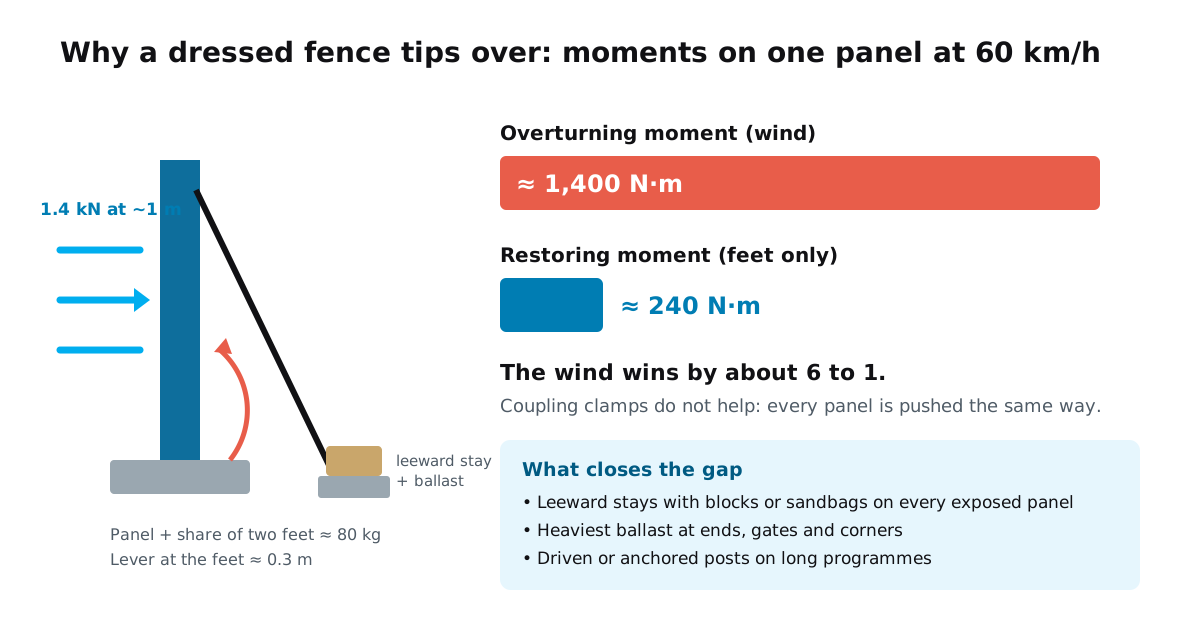
An unbraced temporary fence panel with a full banner can start to tip at a breeze of roughly 25 km/h. Every dressed run needs stays and added ballast, not just more cable ties.
The arithmetic is rough but telling. A panel and its share of two concrete feet weigh around 80 kg, or about 800 N. The feet give a lever of perhaps 0.3 m, so the restoring moment is around 240 N·m. A middle-of-run panel at 60 km/h takes about 1.4 kN acting near 1 m height, an overturning moment of about 1,400 N·m. That is nearly six times what the base can resist. Coupling clamps do not help, because every panel is pushed the same way at the same time.
What good practice looks like on a dressed run:
- Stabiliser stays on the leeward side, ballasted with extra blocks or sandbags, typically every panel on exposed runs and at least every second panel elsewhere. Heavier at ends, gates and corners.
- Driven or anchored posts instead of free-standing feet on long-programme sites. A permanent hoarding with footings is often cheaper than repeatedly re-erecting a dressed temporary line.
- Stays inside the site boundary, never on the footpath side, where they become a trip hazard.
- Leave a gap at the base. Stopping the banner 50 to 150 mm above ground reduces sand build-up against the face and lets water and wind escape.
Fixings are the fuse in the system, and they should be chosen to behave like one:
- Eyelets every 300 to 500 mm on all four sides, closer on end panels. Every eyelet should sit in a welded or double-stitched hem, preferably with webbing reinforcement on PVC.
- Black UV-stabilised nylon ties at minimum. Natural or white ties go brittle quickly under UAE sun. Stainless ties or clips suit programmes beyond a year.
- Ball bungees at ends and corners. They absorb gusts rather than passing the full shock into the eyelet.
- Tension evenly, not tight. PVC softens and grows in the afternoon heat and shrinks overnight. A banner pulled drum-tight at 3 pm is over-stressed by 3 am. Aim for firm with no slack pockets, and re-tension after the first windy week.
Material and print spec for Gulf sun, heat and dust
Specify the banner by programme length and exposure, and write the spec into the purchase order. "Mesh banner, full colour" invites the cheapest media on the market.
| Exposure and programme | Substrate | Ink system | Finishing | Realistic outdoor life (UAE) |
|---|---|---|---|---|
| Open site, up to 24 months | PVC-coated polyester mesh, around 270 to 340 gsm, printed with liner | Solvent, eco-solvent or UV-curable, outdoor-rated | Welded hems, webbing top and bottom, eyelets 300 to 500 mm | 12 to 24 months |
| Sheltered or short event, up to 6 months | Frontlit PVC, 440 to 510 gsm | Solvent, eco-solvent, latex or UV | Welded hems, eyelets 300 mm, pole pockets if framed | 3 to 9 months on fence, longer framed |
| Solid plywood or metal hoarding, 2 years plus | ACP or rigid PVC panels, or self-adhesive vinyl on board | UV or solvent | Anti-UV laminate, sealed edges, mechanical fixing | 3 years plus |
| Privacy or dust screen | Printed knitted HDPE shade net | Solvent or dye-sublimation | Bound edges, reinforced eyelets | 6 to 12 months |
Why the details matter here:
- UV. Solar exposure in the UAE is among the highest of any major market. Reds, oranges and yellows usually fade first. Ask for outdoor-rated pigment inks and avoid large flat areas of a single bright brand colour on programmes over a year.
- Heat. Dark PVC in direct sun gets far hotter than the air. It softens, stretches at the eyelets and creeps. Lighter backgrounds run cooler and hold tension better.
- Liner on mesh. Printing mesh without its liner lets ink pass through the holes, giving weaker colour and contaminated rollers. A printer who skips the liner to save time shows it in the result.
- Dust. A dirty banner looks faded long before it is. Build a quarterly wash-down into the maintenance plan, using water and a soft brush, never a pressure washer on hems.
For files, 72 to 150 dpi at full size is normal for fence-scale work. Insist on outlined text, vector logos and correct brand colour references, and ask for a printed colour proof on the actual substrate for anything brand-critical. Our banner and flex printing page covers the media we run in the Ajman workshop.
Artwork at fence scale
Design the run as a repeating system laid out to the fence's own grid, not as one long poster. Most fence artwork problems come from layouts made on a laptop and stretched along 200 m.
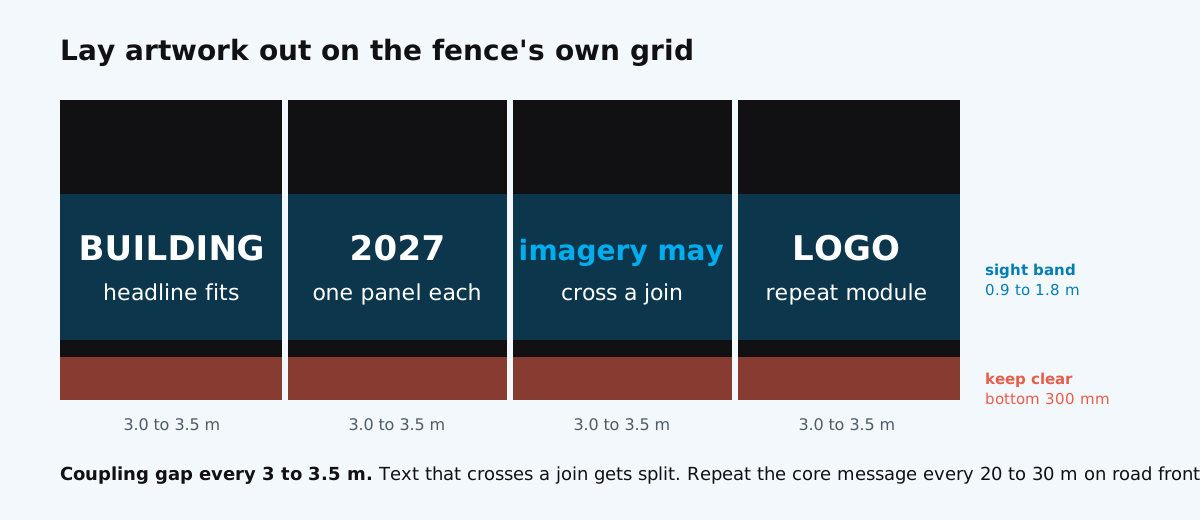
Lay out on the panel grid. Temporary fences have a coupling gap every 3 to 3.5 m. Text that crosses a join gets a vertical gap through a word and often a misalignment between panels. Size the module to a whole number of panels and keep headlines inside a single panel width, or cross joins only with imagery.
Letter height by reading distance. A widely used sign-industry guide is about 25 mm of cap height per 3 m of distance for comfortable reading, roughly 8 mm per metre.
| Viewer | Typical distance | Minimum cap height |
|---|---|---|
| Pedestrian on the footpath | 2 to 5 m | 25 to 40 mm |
| Car in the near lane | 10 to 15 m | 85 to 125 mm |
| Car across a dual carriageway | 30 to 40 m | 250 to 330 mm |
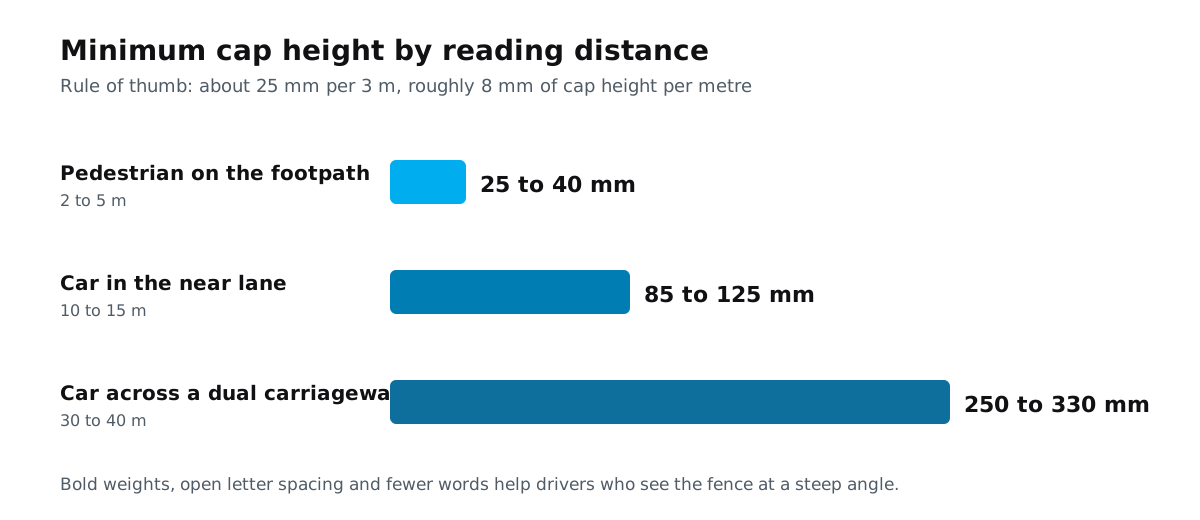
Repeat for the speed of the viewer. At 60 km/h a driver covers about 50 m in a three-second glance. On road frontages, repeat the core message every 20 to 30 m so it is always in view. On pedestrian frontages, use a shorter cycle and allow more detail.
Work in the sight band. On a 2 m fence, the useful zone is roughly 0.9 to 1.8 m above ground, matching driver and pedestrian eye heights. The bottom 300 mm collects sand and splash, so keep logos and text out of it. Drivers also see the fence at a steep angle, which compresses letters horizontally, so favour bold weights, open letter spacing and fewer words.
Bilingual from the first sketch. Arabic is generally expected on commercial signage in the UAE and is often checked during approval. Plan Arabic and English at equal visual weight, typeset Arabic natively rather than converting it in a design tool that cannot shape it, and have a native speaker check it before print.
Keep statutory content separate. Safety signs at gates should use standard ISO 7010 pictograms at the required sizes, in their own positions. Project identification, such as developer, contractor, consultant and permit details, belongs at the main entrance in a clean, readable panel, not hidden in the brand run. See construction site signs and construction site safety signs for those boards.
Permits: who approves fence advertising
In Dubai, displaying an advertisement on a construction fence needs a permit, and which authority issues it depends on where the site is. Settle this before artwork is final.
The framework is Decree No. 6 of 2020 Regulating Advertisements in the Emirate of Dubai. It states that no one may display an advertisement in any advertising space without first obtaining a permit, issued under a manual that sets technical, engineering, safety and placement requirements. Depending on location, the competent entity can be Dubai Municipality, the RTA, the economic department, a special development zone authority or a free zone authority.
The practical consequence is that the same banner can need different routes on different plots:
| Site location | Typical route |
|---|---|
| General Dubai mainland | Dubai Municipality advertising permit |
| TECOM free zones (Media City, Internet City, Studio City and others) | DDA advertising permit, which lists "Construction Fence" as a category. Outside those zones, DDA only issues a structural NOC and the permit comes from Dubai Municipality |
| Other free zones and master communities | The zone or master developer's own approval, often alongside the authority permit |
| Road-facing frontages | Check whether RTA requirements apply in addition |
| Sharjah and Ajman | The municipality of each emirate, under its own advertising rules |
For the DDA route, the published requirements include a location map or site plan and the trade licence, plus a Dubai Municipality consumer products NOC where a consumer product is advertised. Other authorities typically ask for similar items, plus visuals of the artwork and details of the structure and fixing.
Three things that regularly cause delays:
- Third-party advertising. Selling fence space to brands changes how the authority sees the hoarding. Clear it with the authority and the master developer first.
- Content. Imagery and copy must suit UAE media standards. Project renders showing unapproved designs can also create problems with the developer.
- Changes after approval. A new phase or new launch artwork can mean a new submission, so build that into the marketing calendar.
Rules, categories and fees are revised from time to time. Confirm the current requirements with the authority for the specific plot rather than relying on a previous project.
Installation and inspection checklist
Use this as a hold-point list between the signage contractor and site HSE. Most items take minutes. Skipping them is where the incident reports come from.
Before printing
- Perimeter surveyed: total length, panel count, gates, corners, slopes and any free ends marked
- Exposure assessed for each run (open plot, road frontage, coastal, sheltered) and material chosen per run
- Ballast and stay layout agreed with the temporary works engineer for dressed runs
- Permit route confirmed and approval in hand, or a submission date agreed
- Artwork checked against the panel grid; Arabic proofread by a native speaker
- Spare panels ordered, typically 5 to 10 percent of the run, printed in the same batch for colour match
On installation day
- Site induction, PPE and a permit to work where the site requires one
- Roadside work planned for low-traffic hours, with traffic management if the footpath or lane is affected
- Stays and added ballast fitted before the banner goes up, not after
- Ties at every eyelet; bungees at ends and corners; base gap kept clear
- Installation avoided during active wind warnings
- Photo record of every run handed to the site team
Through the programme
- Weekly walk-round of the full perimeter; after every wind warning, a same-day check
- Broken ties, torn eyelets and leaning panels fixed within 24 hours
- Quarterly wash-down and a colour check against the spare panels
- Sand cleared from the base of runs after dust events
- At demobilisation, banners removed before the fence is dismantled and sent to a recycler where one accepts PVC banner material
Frequently asked questions
Is mesh always better than PVC for fence banners?
On open, exposed fence lines, yes. It cuts peak loads at ends and corners and stops the flutter that fatigues eyelets. It does not remove the wind load, so stays and ballast are still needed. Solid PVC is the better choice in sheltered or framed positions where image quality matters.
How much wind load does a fence banner add?
For a fully covered 3.5 m × 2.0 m panel, roughly 2.5 kN in the middle of a run and close to 5 kN at a free end at 80 km/h. Mesh reduces this modestly, more at the ends than in the middle.
How long do fence banners last in the UAE?
Properly specified mesh with outdoor-rated inks and welded hems typically lasts 12 to 24 months on an open site. Solid PVC on a fence usually lasts a few months to under a year. Fixings and maintenance decide the real figure more than the media.
What spacing should eyelets have?
300 to 500 mm on all sides, at the closer end for end panels and exposed runs, set in welded or double-stitched hems.
Do construction fence banners in Dubai need a permit?
Advertising on a construction fence needs a permit under Decree No. 6 of 2020. The issuing authority depends on the location, for example Dubai Municipality on the mainland or DDA in TECOM free zones.
What letter height is readable from a passing car?
About 85 to 125 mm for the near lane, and 250 mm or more for traffic across a dual carriageway.
Sources
- Decree No. (6) of 2020 Regulating Advertisements in the Emirate of Dubai, Dubai Legislation Portal
- Advertising Permit, Dubai Development Authority
- Dubai residential buildings cannot feature ads any longer, Gulf News
- Mesh-banner fence wind load study, CFD analysis of temporary grandstand enclosures, 2020
- Understanding Meteorology in the UAE: the 40-day Shamal, Emirates Natural History Group
- Summer shamal season, NASA Earth Observatory
- EN 1991-1-4, Eurocode 1: Wind actions, section 7.4 on free-standing walls and fences (pressure coefficients are approximate, quoted from the standard's tables)