Impact-resistant signs · Ajman factory

Polycarbonate Sign Panels and Faces in Dubai, Sharjah & Ajman

Bayan Signage makes polycarbonate signs for schools, sports halls, car parks, industrial sites and lightbox faces across the UAE. We cut, reverse-print and assemble every panel in our Ajman factory, choose hard-coated and UV-protected grades where they are needed, and fit them with fixings that allow the sheet to move in summer heat.

Blank white panel sign in a black frame mounted on a weathered brick wall
Illustrative photo · Unsplash
2016Factory established in Ajman
500+Clients across the UAE
In-houseDesign, fabrication and installation
24 hTypical quote turnaround
Prepared by Bayan Signage production & estimating teamFactory: Alam Square, Industrial Area 2, AjmanUpdated
Polycarbonate Signs in the UAE

Polycarbonate signs for places where signs get hit

A polycarbonate sign uses a clear, tough engineering plastic sheet, known by trade names such as Lexan and Makrolon, where an acrylic sign would crack. Polycarbonate is commonly quoted as around 200 times stronger than glass in impact tests, so a football, a kick or a trolley usually leaves a mark rather than a hole. It suits schools, gyms, car parks, warehouses, transport sites and public corridors, and it forms the face of most large backlit fascia signs because big faces must flex without breaking.

Polycarbonate is not a better acrylic in every way, and treating it as one causes most of the failures we see. Standard sheet scratches easily, so it hazes after months of cleaning unless a hard-coated grade is used. Unprotected sheet yellows in sunlight. It expands with heat and pops out of tight frames. Ammonia glass cleaners attack it. Our Ajman factory specifies hard-coat and UV grades by location, prints graphics on the reverse so scratches never touch them and drills oversized holes for movement.

Bayan Signage has fabricated signs at Alam Square, Industrial Area 2, Ajman, since 2016 as the production arm of Bayan Advertising, with 15 years in the UAE. We cut polycarbonate on our CNC routers, print on our large-format UV printers and build lightboxes with in-house LED assembly, so a tough sign or a large illuminated face comes from one team.
Trusted by 500+ UAE businesses, including

Al-Futtaim logoAl Ghurair logoMultiply Group logoAriston Group logoCARS24 logoDouble A logo
Our process

How we make polycarbonate signs in our Ajman factory

  1. Site and use review

    We ask what the sign will face: balls, trolleys, cleaning machines, sun through glazing or outdoor exposure. That decides the grade, thickness, backing and fixings. The survey is free in Dubai, Sharjah and Ajman.

  2. Design and drawing

    Designers lay out the graphics in reverse for second-surface printing; draftsmen detail sheet size, corner radii, hole positions and expansion gaps for each panel.

  3. CNC cutting

    Sheets are CNC-routed to size with radiused corners and oversized fixing holes. Protective film stays on the face until installation to keep the hard coat clean.

  4. Reverse printing

    Graphics are printed on the back of the sheet on our UV printers, or reverse-applied vinyl is used, followed by a white or colour flood so the panel reads opaque.

  5. Assembly and QC

    Panels are bonded to aluminium or ACP backing or fitted into frames. Lightbox faces are checked for even light with our LED test, and every sign is matched to the approved artwork.

  6. Installation

    Our crew fixes panels with security screws or concealed fixings, leaves room for expansion and briefs your facility team on safe cleaning products.

Specification

Polycarbonate sign specification

Our standard vandal-resistant build is below. Lightbox faces follow a separate specification set by the box size and LED layout.

ComponentOur standardUpgrade optionsWhy it matters
Sheet4 to 5 mm polycarbonate6 mm or more for heavy-abuse areasThickness sets stiffness and how much punishment the panel absorbs.
SurfaceHard-coated faceMatt hard coat, anti-graffiti gradeStandard sheet hazes with cleaning; hard coat keeps it clear.
UV protectionUV-protected sheet where daylight reaches itUV-stable inks and laminateUnprotected polycarbonate yellows and turns brittle in strong sun.
GraphicsReverse printed with flood backingReverse-applied vinyl, multi-layer printSecond-surface graphics cannot be scratched or tagged.
Backing2 to 3 mm aluminium or ACPAluminium frame, rounded edge trimBacking adds rigidity against kicks and punches.
FixingsSecurity screws, oversized holesConcealed fixings, framed mountingRoom for expansion stops bowing and cracking at the holes.
Our work

Inside our Ajman factory

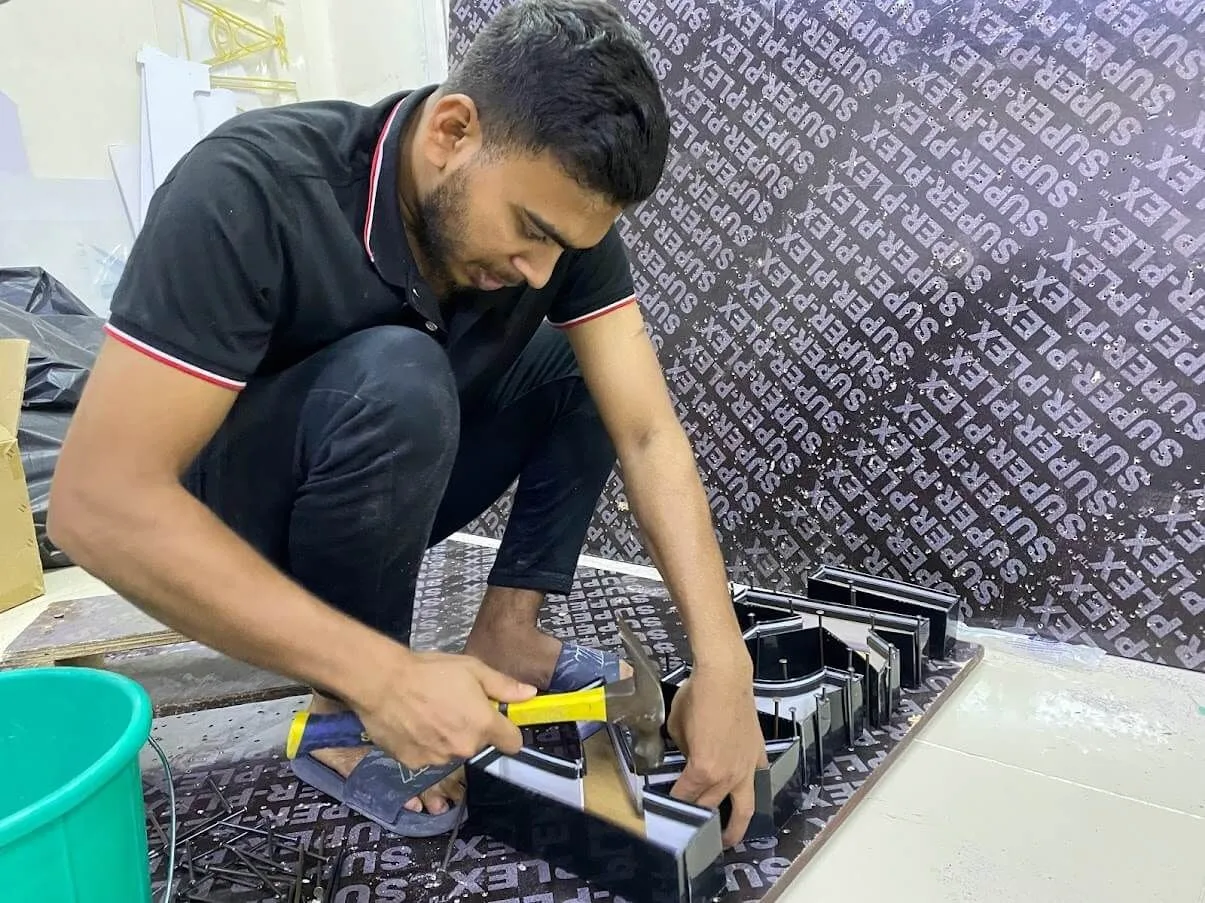
Bayan Signage technician assembling a sign in the Ajman workshop
Assembly in our Ajman workshop
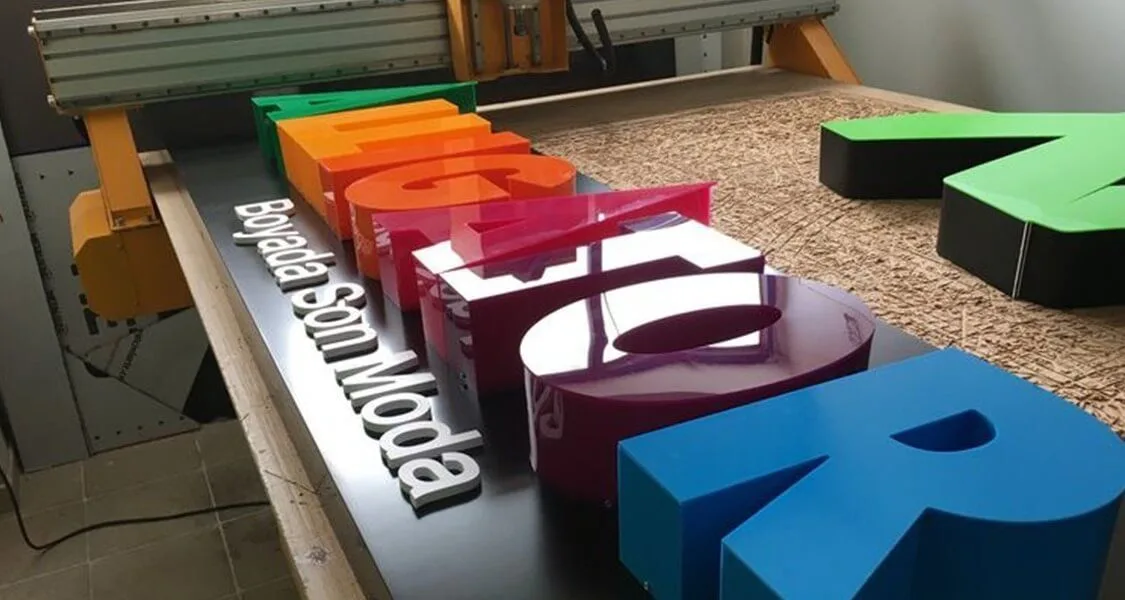
CNC-cut acrylic sign parts on the router bed at the Bayan Signage factory
CNC-cut acrylic parts on the router bed
Stainless steel sign components on the fabrication bench in Ajman
Stainless steel work on the fabrication bench
Expert advice

Advice from our fabrication team

Polycarbonate solves real problems when it is specified properly. These are the points that decide whether it does.

Fit the UV side towards the light

UV-protected polycarbonate is protected on one face only, marked on the protective film. Fit it backwards and the sheet yellows within a few summers of UAE light. Our installers check the film before peeling it, and on sheets that will be cut into many pieces we mark the UV face on each one so it cannot be lost in the workshop.

Drill big holes, fix loosely

Polycarbonate expands about 0.065 mm per metre per degree. A 2 m panel warming by 40°C grows around 5 mm. Tight holes and fully torqued screws make it bow or crack at the fixings. We drill oversized holes, use washers that allow movement and leave expansion gaps in frames and lightbox channels.

Brief the cleaners

Ammonia glass cleaners, strong solvents, abrasive pads and dry wiping all damage polycarbonate, and some cause fine cracking around holes. Lukewarm water, mild soap and a soft cloth are all it needs. We give your facility team a one-page care note at handover, because one wrong spray bottle can undo the hard coat in a term.

Do not use it where acrylic is better

In a reception or boardroom where nobody will hit the sign, acrylic is clearer, harder on the surface, polishes to a glass-like edge and usually costs less. Polycarbonate earns its price in gyms, car parks, schools and lightbox faces. We would rather sell you the right material than the dearer one.

Cold-bend within limits

Polycarbonate can be curved around a column without heating, to a minimum radius of roughly 100 to 150 times its thickness, so 3 mm sheet bends to about 300 to 450 mm. Hard-coated grades need a larger radius. We check the curve on the drawing before cutting, because over-bending cracks the coating.

Pricing

Polycarbonate sign price in Dubai: what affects the cost

We quote from the size, quantity and where the signs will live. Send the artwork, dimensions and a photo of the location, and you receive an itemised quote, usually within 24 hours.

Sheet grade

Standard polycarbonate costs more than acrylic of the same thickness. Hard-coated, UV-protected and flame-rated grades add more but solve real problems.

Thickness and size

Thicker sheets and large faces use more material and need careful handling. Faces larger than a standard sheet need joints or special sizes.

Forming

Flat panels are economical. Cold-bent curves add labour, and thermoformed pan faces with raised logos need moulds and longer lead times.

Graphics

Reverse printing with a flood backing is standard. Multiple layers and close colour matching add production steps.

Backing, frames and fixings

Aluminium backing, frames, rounded edges and security fixings add hardware and fabrication compared with a simple panel.

Quantity

Sets of matching signs for a school or site share set-up cost, which lowers the price per sign compared with one-off pieces.

Approvals

Polycarbonate sign fire and safety requirements

Some buildings, and some Civil Defence requirements, specify flame-retardant materials for certain signs, covers and lightbox faces, particularly in escape routes, car parks and public assembly areas. Polycarbonate grades with improved fire performance are available. Requirements depend on the building and the sign's location, so we confirm the current requirement for your site before ordering sheet.

Outdoor lightboxes with polycarbonate faces usually need the same municipality, free-zone or landlord approval as any illuminated sign, and our draftsmen prepare the drawings for those submissions. Schools and sports facilities may also have their own safety rules on corner radii and fixing heights, which we design to.

Why Bayan Signage

Why schools and facility teams choose Bayan Signage for polycarbonate signs

Made in our Ajman factory

CNC cutting, UV printing, LED assembly and finishing all happen under one roof, and you can visit during production.

Grade chosen per location

We specify hard-coated, UV-protected or standard sheet by where each sign will sit, rather than one grade for everything.

Graphics that cannot be scratched

Reverse printing puts the artwork behind the sheet, so keys, cleaning pads and graffiti only meet the protective face.

Fixed to allow movement

Oversized holes and expansion gaps are drawn on every panel, so signs stay flat through the summer.

Honest material advice

We tell you when acrylic or Forex will serve better and cost less, and save polycarbonate for places that need it.

Itemised quotes in 24 hours

Sheet, printing, backing, fixings and installation are listed separately, so you can compare quotes like for like.

FAQ

Polycarbonate Signs questions we are asked most

How much does a polycarbonate sign cost in Dubai?

It depends on the sheet grade, thickness and size, any forming, the graphics, backing and fixings, and the quantity. A set of matching reverse-printed school panels costs less per sign than a single large curved panel with a frame. Send your artwork and a site photo, and we will send an itemised quote, usually within 24 hours.

Is polycarbonate the same as acrylic?

No. Both are clear plastic sheets, but polycarbonate is far more impact resistant and flexible, while acrylic is clearer, harder on the surface and easier to polish. Polycarbonate suits signs that might be hit or must bend; acrylic suits premium indoor signs where looks matter most.

Is polycarbonate really unbreakable?

Not truly, but it is very hard to break in normal use. Balls, kicks and knocks usually leave marks rather than cracks. Very thin sheet can be cut or punctured with tools, and strong UV without protection makes it brittle over time, which is why we specify UV grades where light reaches the sign.

Does polycarbonate scratch easily?

Standard polycarbonate is softer than acrylic and scratches more easily, especially with rough cloths or dry wiping. Hard-coated grades are much more scratch resistant and are our standard for public areas. Reverse printing also keeps graphics safe from scratches on the face.

Why are lightbox faces usually polycarbonate?

Because large faces have to flex without cracking. A 3 to 4 m face must survive transport, installation, wind and ladders, and polycarbonate handles all of these far better than acrylic. It can also be thermoformed into pan faces with raised logos.

Can polycarbonate signs be used outdoors in the UAE?

Yes, with UV-protected sheet fitted with the protected face towards the sun, UV-stable inks and fixings that allow for expansion. Without UV protection, sheet yellows and turns brittle within a few summers here. It is widely used for outdoor lightbox faces and protective covers.

How do I clean a polycarbonate sign?

Use lukewarm water with mild soap and a soft cloth or sponge, then rinse and dry gently. Avoid ammonia glass cleaners, strong solvents, abrasive pads and dry wiping. For graffiti on hard-coated sheet, use a remover approved for polycarbonate and test it on a corner first.

Do you install polycarbonate signs across the UAE?

Yes. Our crews install across all seven emirates from our Ajman factory, including school campuses, sports facilities, car parks and lightbox face replacements. School and occupied sites can be done outside teaching or opening hours.

Free quote

Get a quote for polycarbonate signs

Send your logo, the fascia size and a site photo. Our estimating team replies with options and an itemised price, usually within 24 hours.

  • Call or WhatsApp +971 56 637 2656
  • Workshop: Alam Square, Industrial Area 2, Ajman
  • Sunday to Thursday, 08:00 to 18:00