Clinical signage maker · Ajman factory

Infection Control Signage for Hospitals in Dubai & the UAE

Bayan Signage produces infection control signage for hospitals, clinics, dental groups and long-term care facilities from its factory in Ajman. We print your infection prevention team's approved content on faces chosen for your disinfectants, build swappable isolation holders and racks, and test samples with your own cleaning products before a full set is made.

Infection control sign with gold hand washing symbol mounted on a dark teal wall
Illustrative photo · Unsplash
2016Factory established in Ajman
500+Clients across the UAE
In-houseDesign, fabrication and installation
24 hTypical quote turnaround
Prepared by Bayan Signage production & estimating teamFactory: Alam Square, Industrial Area 2, AjmanUpdated
Infection Control Signs in the UAE

Infection control signage your staff will trust

Infection control signage is the set of signs that tells staff and visitors which precautions apply in a space: contact, droplet and airborne isolation signs at room entrances, hand hygiene prompts at sinks and alcohol rub stations, PPE donning and doffing sequences in anterooms, and restricted-zone notices for theatres, sterile services and negative pressure rooms. Hospitals, day surgery units, dental and dermatology clinics, laboratories and care homes all rely on it, and it is wiped more often than almost any other surface in the building.

The content belongs to your infection prevention team; the durability belongs to the sign maker. A good system uses a short, standardised set of designs, colour-coded to your own policy, on faces with no texture, sealed edges and ink protected from the cloth. Standard acrylic can craze when alcohol and solvent cleaners meet stressed laser-cut edges, which is why our factory prints many faces in reverse on polycarbonate and rounds every corner. We test before we recommend.

Bayan Signage is the production arm of Bayan Advertising, a UAE group with 15 years in the market, and our Ajman factory has made signs since 2016. Everything is produced in-house: CNC-cut holders, UV-printed faces, magnetic plates and storage racks. One project manager works with your infection prevention and facilities leads, so the approved wording, the colour code and the number of spare sets per ward are agreed once and followed on every reorder.

Trusted by 500+ UAE businesses, including

Al-Futtaim logoAl Ghurair logoMultiply Group logoAriston Group logoCARS24 logoDouble A logo
Our process

How we make infection control signage in our Ajman factory

  1. Policy and content review

    We start from your infection prevention policy: precaution types, colour code, approved wording and pictograms. Our designers lay out the set, and nothing is invented by us.

  2. Chemical wipe test

    We ask which disinfectants your environmental services team uses, then send face and edge samples for your team to wipe repeatedly, exactly as on the ward. The material choice follows the result, not a datasheet.

  3. Artwork approval in both scripts

    Each sign is proofed in Arabic and English at full size, with the action in the top third and the headline at 30 to 50 mm, then signed off by your infection prevention lead.

  4. Printing and finishing

    Faces are UV-printed, often in reverse on clear polycarbonate. Substrates are CNC-cut with rounded corners, edges polished and magnetic backs applied, then checked against the approved artwork.

  5. Holders, racks and spare sets

    We supply flush holders for each door and a labelled rack for every nurse station, filled with the agreed spare sets so the right sign is always in reach.

  6. Installation under your permit

    Holders are fixed and sealed around the perimeter with hygienic silicone, under your infection control permit, in short windows that suit bed availability and cleaning schedules.

Specification

Infection control signage specification

This is our standard build for swappable precaution signs and fixed sink signs. We adapt it to your chemicals and policy, and itemise each change.

ComponentOur standardUpgrade optionsWhy it matters
FaceReverse-printed clear polycarbonate, mattChemical-resistant overlaminate, antimicrobial sheet if specifiedCloths never touch the ink, and polycarbonate tolerates alcohol and chlorine better than acrylic.
Substrate2 mm rigid PVC or ACP, 5 mm corner radiusSolid polycarbonate throughoutRounded corners do not snag gloves or chip when signs are swapped all day.
Swappable fixingMagnetic sheet back on a flush steel plateSlide-in frame with top loadingSigns go up and come down with each patient in seconds, without tape.
Wall holderSteel plate sealed with hygienic siliconeRecessed holder in new wall liningsNo gap behind the holder where fluid and dirt can collect.
StorageLabelled wall rack at each nurse stationLockable drawer unitThe correct sign is to hand when status changes, so nobody improvises on paper.
Fixed sink signsReverse-printed panel on high-bond tapeStainless stand-offs above splash zoneSits clear of the 300 to 500 mm splash zone and wipes clean.
Our work

Inside our Ajman factory

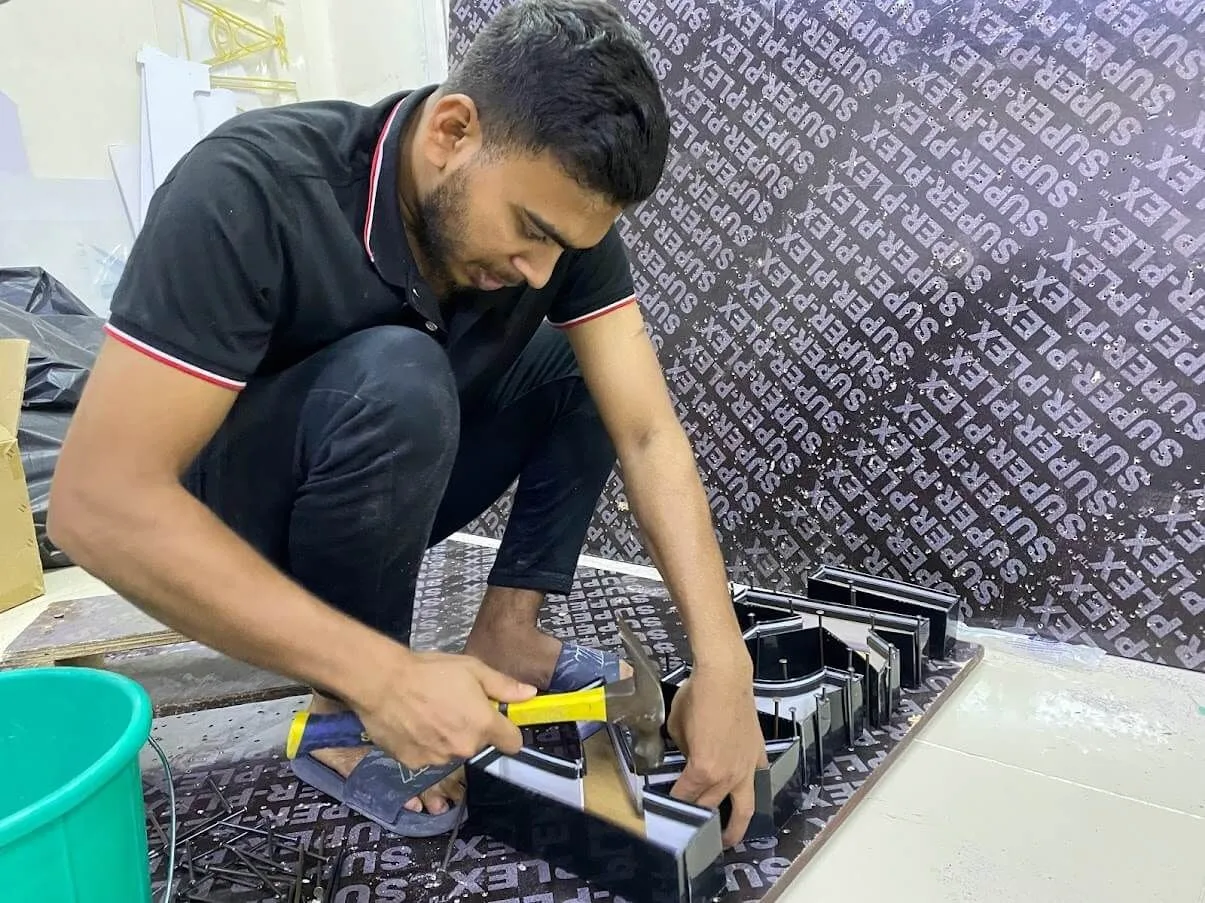
Bayan Signage technician assembling a sign in the Ajman workshop
Assembly in our Ajman workshop
CNC-cut acrylic sign parts on the router bed at the Bayan Signage factory
CNC-cut acrylic parts on the router bed
Stainless steel sign components on the fabrication bench in Ajman
Stainless steel work on the fabrication bench
Expert advice

Advice from our clinical signage team

Precaution signs are read in a second or two at a doorway. These points decide whether that second is enough.

Lead with the action, not the explanation

Staff decide at the threshold whether to put on gloves and a gown. Put the required PPE as pictograms in the top third of the sign, at least 40 to 60 mm wide, with a headline of 30 to 50 mm. Explanations of transmission belong in training, not on the door. If a precaution sign needs more than about 25 words, it is doing the wrong job.

Give precaution colours their own territory

If your isolation colours match your wayfinding zones or the colour of a waste bag, staff will misread them, especially agency nurses who move between facilities. We map every colour already in use in the building before artwork starts and suggest a precaution palette that clashes with none of them.

Stock for an outbreak, not an average week

Isolation signs are only useful if the right one is in the rack. We recommend at least two of each precaution type per nurse station, more on respiratory and infectious diseases wards. Ordering the full stock in one print run costs far less than urgent reprints during a surge, when a laminated sheet is otherwise the fallback.

Be wary of antimicrobial claims

Antimicrobial additives may reduce some microbes on a surface over time, but the effect depends on contact time and cleaning practice. A smooth, sealed, crevice-free sign that is wiped properly matters more. If your policy specifies antimicrobial finishes we source them; otherwise we put the budget into reverse printing and sealed edges.

Never put the patient on the sign

A precaution sign should say what to do, not who is inside or what they have. Naming a diagnosis on a door breaches privacy and causes stigma. Keeping signs generic also means the same face is reused for the next patient, which is how a small set of durable signs lasts for years.

Pricing

Infection control signage price in Dubai: what affects the cost

We price from your list of sign types, quantities and locations. Send your policy extract or current signs and a few photos, and you will usually receive an itemised quote within 24 hours.

Swappable or fixed

Magnetic plates and slide-in holders add a fixed part at each room. Fixed signs cost less per location but more over time if content changes.

Face material

Reverse-printed polycarbonate and chemical-resistant laminates cost more than printed PVC, and outlast it under daily disinfectant wiping.

Number of variants

Each precaution type, language layout and size is a separate artwork and print setup. A short standard set keeps cost and confusion down.

Edge finishing and sealing

Rounded corners, polished edges and perimeter sealing add time per sign, and are worth it beside sinks and in isolation rooms.

Spare stock quantities

Spare sets for every station are cheaper printed in one run than reprinted urgently during an outbreak.

Site conditions

Installing holders in occupied isolation areas needs permits, PPE for our installers and short work windows, which affect labour.

Approvals

Infection control signage standards in the UAE

There is no single UAE-wide design that every facility must use. Health regulators such as the DHA, DoH and MOHAP typically expect a documented infection prevention programme, and accreditation surveys look for consistent signage that supports it. The wording and colour code should come from your own policy; we reproduce it accurately and confirm the format with your team.

For mandatory PPE, prohibition and warning symbols we follow ISO 7010 style pictograms wherever a recognised symbol exists, because they read across languages. Exit and fire signs on the same corridors follow Dubai Civil Defence or the local authority. Requirements vary between facilities, so we confirm the current expectations for your site.

Why Bayan Signage

Why facilities choose Bayan Signage for infection control signage

Made and tested in-house

Faces, holders and racks are printed, cut and assembled at our Ajman factory, and samples are wiped with your own disinfectants before we commit.

Your policy, reproduced exactly

We work only from approved content and colour codes, and proof every sign in Arabic and English for sign-off by your infection prevention lead.

Fast reorders

We keep the artwork for every set we print, so replacement faces and extra stock for a new ward match the originals without starting again.

One accountable contact

A single project manager coordinates content, samples, production and installation with your infection prevention and facilities teams.

Itemised, honest quotes

Holders, faces, racks, spare stock and installation are listed separately, so procurement can see what each part of the system costs.

500+ clients across the UAE

Healthcare operators, national retail groups and international brands rely on our factory, and most of our work comes from repeat clients.

FAQ

Infection Control Signs questions we are asked most

How much does infection control signage cost in Dubai?

It depends on the number of sign types, quantities, face material and whether you need swappable holders and racks. A standard set of reverse-printed precaution faces with magnetic holders for one ward costs far less than a full hospital rollout with PPE boards in every anteroom. Send your list and photos for an itemised quote, usually within 24 hours.

What colours should isolation precaution signs use?

Colours should come from your hospital's infection prevention policy, because there is no single code every UAE facility follows. Many facilities give contact, droplet and airborne precautions distinct colours and keep them different from wayfinding and waste colours. We match your code exactly, or suggest a clear set if you are starting from scratch.

Which material survives hospital disinfectants best?

Reverse-printed polycarbonate and chemical-resistant overlaminates usually perform best with alcohol, chlorine and peroxide-based products. Standard acrylic can craze with some solvents. Because each facility uses different products, we ask for your list and have samples wiped with them repeatedly on site before recommending a material.

Can isolation signs be changed without tools?

Yes. Most of our precaution systems use a flush magnetic plate or a slide-in holder fixed beside each door. A nurse takes the correct face from the rack at the station, places it in seconds and returns it when precautions end. The holder stays on the wall and is cleaned with the room.

Can you produce PPE donning and doffing boards?

Yes. We make step-by-step boards with pictograms and short bilingual instructions, usually A3 or A2, for anterooms and changing areas. The sequence comes from your infection prevention team, because practice can differ between facilities. We fix them where staff stand to dress, ideally beside a mirror.

How long does it take to supply infection control signs?

It depends on quantity, material and how many layouts need approval, so we give you a realistic schedule with the quote. Reorders of existing artwork are simpler because no design work is needed. If guidance changes suddenly, we can print approved replacement faces to fit the holders we have already installed on your walls.

Do you supply clinics outside Dubai?

Yes. We produce everything in Ajman and deliver and install across all seven emirates, including Sharjah, Abu Dhabi, Ras Al Khaimah and Fujairah. Site surveys are free in Dubai, Sharjah and Ajman, and replacement faces can be sent from the artwork we keep on file.

Free quote

Get a quote for infection control signs

Send your logo, the fascia size and a site photo. Our estimating team replies with options and an itemised price, usually within 24 hours.

  • Call or WhatsApp +971 56 637 2656
  • Workshop: Alam Square, Industrial Area 2, Ajman
  • Sunday to Thursday, 08:00 to 18:00