Road sign manufacturer · Ajman factory

Reflective Road Signs in Dubai, Sharjah, Ajman & Abu Dhabi

Bayan Signage fabricates reflective road signs for master communities, industrial areas, campuses and private roads from its own factory in Ajman. We cut the aluminium, laminate the retroreflective sheeting, weld the posts and install the full set, and every permanent outdoor sign carries a 5-year warranty on structure and powder coat.

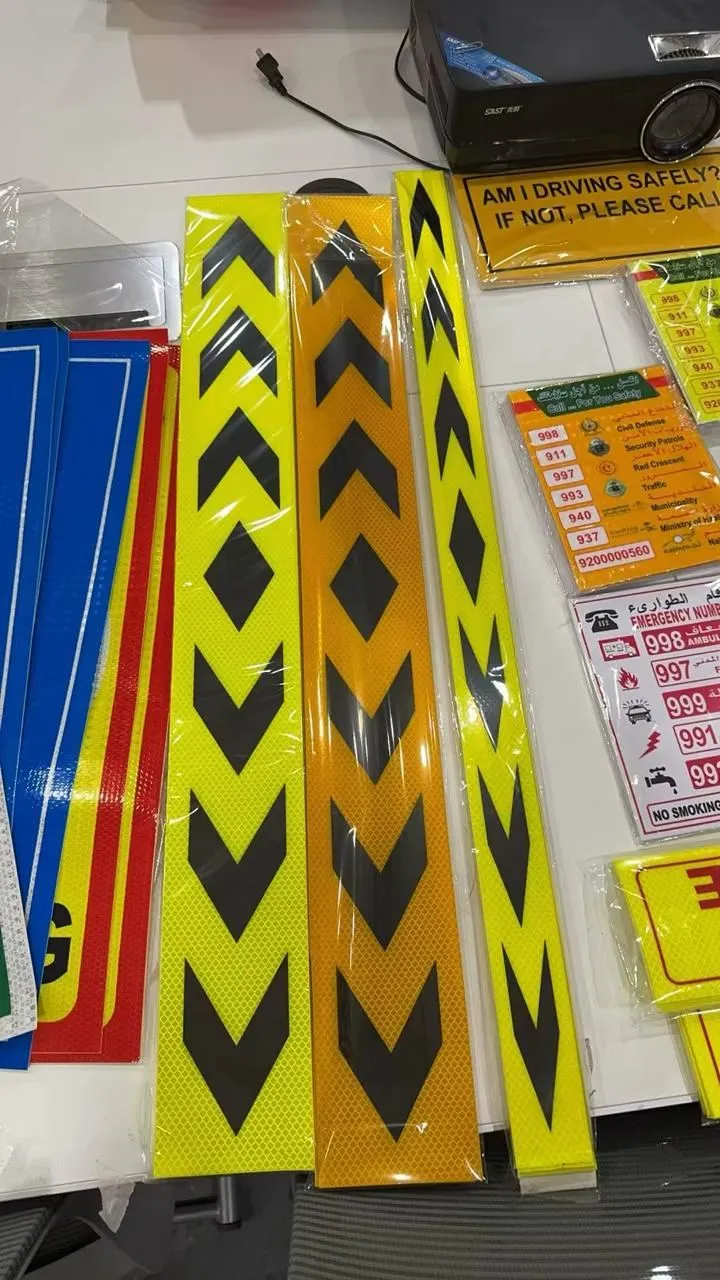
Yellow and black reflective chevron panels for reflective road signs, made by Bayan Signage
2016Factory established in Ajman
500+Clients across the UAE
In-houseDesign, fabrication and installation
24 hTypical quote turnaround
Prepared by Bayan Signage production & estimating teamFactory: Alam Square, Industrial Area 2, AjmanUpdated
Reflective Road Signs in the UAE

Reflective road signs, made and installed by one team

Reflective road signs are traffic signs faced with retroreflective sheeting, which sends the light from a car's headlamps straight back towards the driver, so the sign appears to glow at night without any power supply. We make them for the roads that owners and contractors are responsible for: master community streets, industrial and free-zone plots, logistics yards, hospital and university campuses, and private roads built to a consultant's specification.

The quality of a road sign is decided in places a client rarely looks. The sheeting grade has to suit the road speed, the plate has to stay flat through 50 °C afternoons, and the sheeting has to go onto clean metal without trapped air or lifted edges, because sand and water always attack the edges first. In our Ajman factory we CNC-cut every blank, laminate the sheeting under roller pressure and check each finished face with a torch held at eye level before it is packed.

Bayan Signage is the production arm of Bayan Advertising, which has worked in the UAE for 15 years, and our factory at Alam Square, Industrial Area 2, Ajman has been making signs since 2016. Our draftsmen read road-authority and consultant specifications every week, and the crew that welds the galvanised posts in our workshop is the same crew that sets them in concrete on your road.

Trusted by 500+ UAE businesses, including

Al-Futtaim logoAl Ghurair logoMultiply Group logoAriston Group logoCARS24 logoDouble A logo
Our process

How we make reflective road signs in our Ajman factory

  1. Sign schedule and site walk

    We start from your layout or the consultant's schedule, then walk or drive the route to check every position for sightlines, lamp posts, trees and buried services. The survey is free in Dubai, Sharjah and Ajman.

  2. Specification and artwork

    Our draftsmen set each sign's size, sheeting grade and post from the road speed and the specification, and lay out the legends and Arabic text at true scale for your sign-off.

  3. CNC cutting and plate preparation

    Aluminium blanks are CNC-routed to shape with radiused corners, the edges are deburred and the faces degreased, so the sheeting bonds to clean metal rather than to oil or workshop dust.

  4. Sheeting and legends

    Retroreflective sheeting is laminated onto the plate under roller pressure, then legends go on as cut sheeting or matched overlay film, so colour and night brightness stay consistent across the whole set.

  5. Posts, brackets and torch check

    We cut and weld the galvanised posts and brackets, treat every weld, and inspect each finished face with a torch held beside the eye, which shows weak or patchy sheeting immediately.

  6. Installation and night handover

    Our crew sets out positions, casts the footings, fixes each sign at the agreed height with a slight turn away from the carriageway, and drives the route after dark before handover.

Specification

Reflective road sign specification

This is our starting point for permanent reflective road signs on private and community roads. Where a road authority or consultant sets a different standard, theirs takes priority and we build to it.

ComponentOur standardUpgrade optionsWhy it matters
Plate2 to 3 mm aluminium sheet, radiused cornersExtruded aluminium planks with back bracingAluminium does not rust at bolt holes and stays flat in summer heat, where steel corrodes and plastic warps.
SheetingHigh intensity prismaticFull-cube microprismatic; fluorescent yellow-greenHigher grades return more light over wider angles, which matters at speed and at busy junctions.
LegendsCut sheeting or matched overlay filmDigital print with matched inksA matched system keeps legend colour and night brightness equal to the sheeting underneath.
PostsGalvanised steel tube, 60 to 90 mmPowder coat in a community colourPost size follows sign area and wind; galvanising protects the steel where it meets the soil.
FixingsGalvanised or stainless clamps, anti-theft nutsIsolating washers for coastal roadsGood clamps stop signs twisting in gusts; isolating washers stop aluminium and steel corroding each other.
FoundationConcrete footing sized to the sign areaBase plate onto an existing slabAn undersized footing is the usual reason a sign leans after its first shamal season.
Our work

Inside our Ajman factory

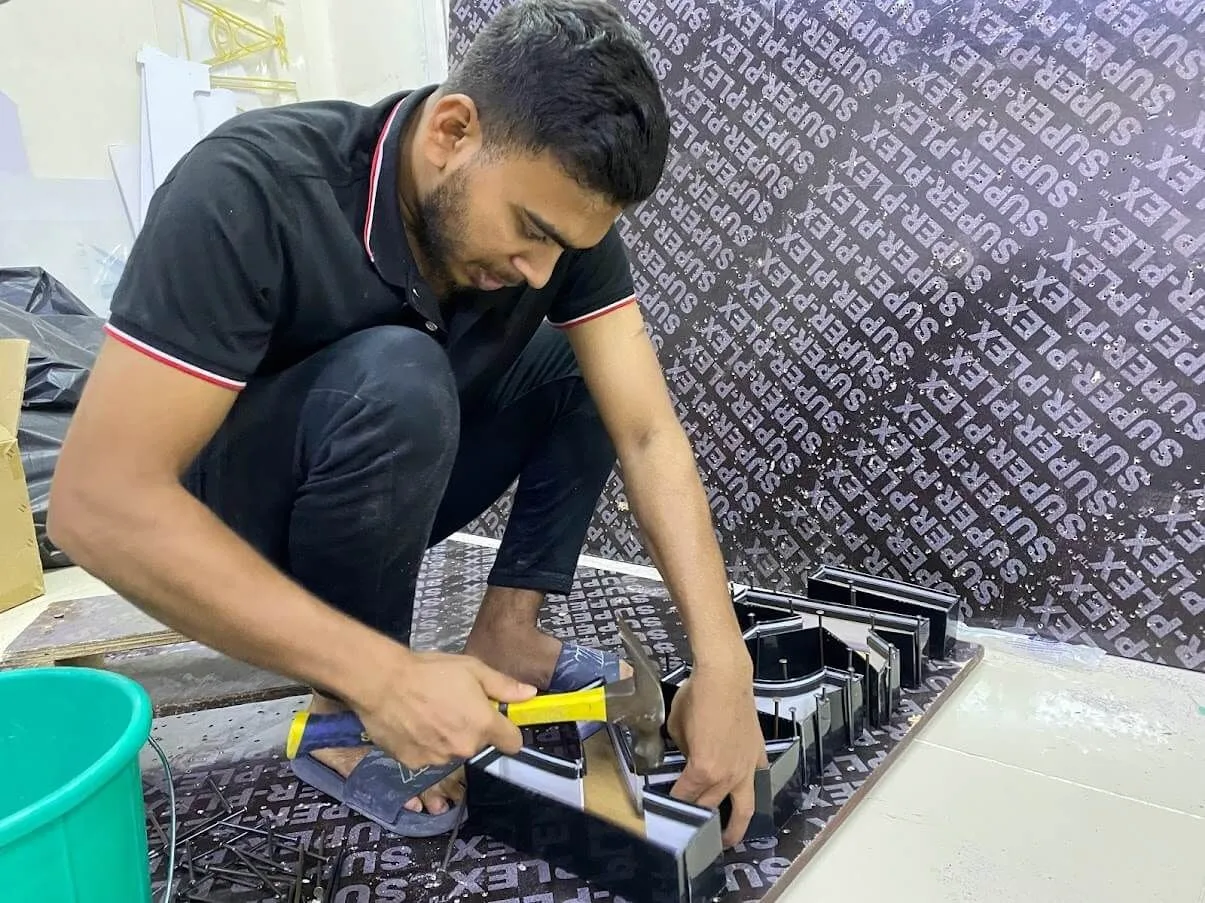
Bayan Signage technician assembling a sign in the Ajman workshop
Assembly in our Ajman workshop
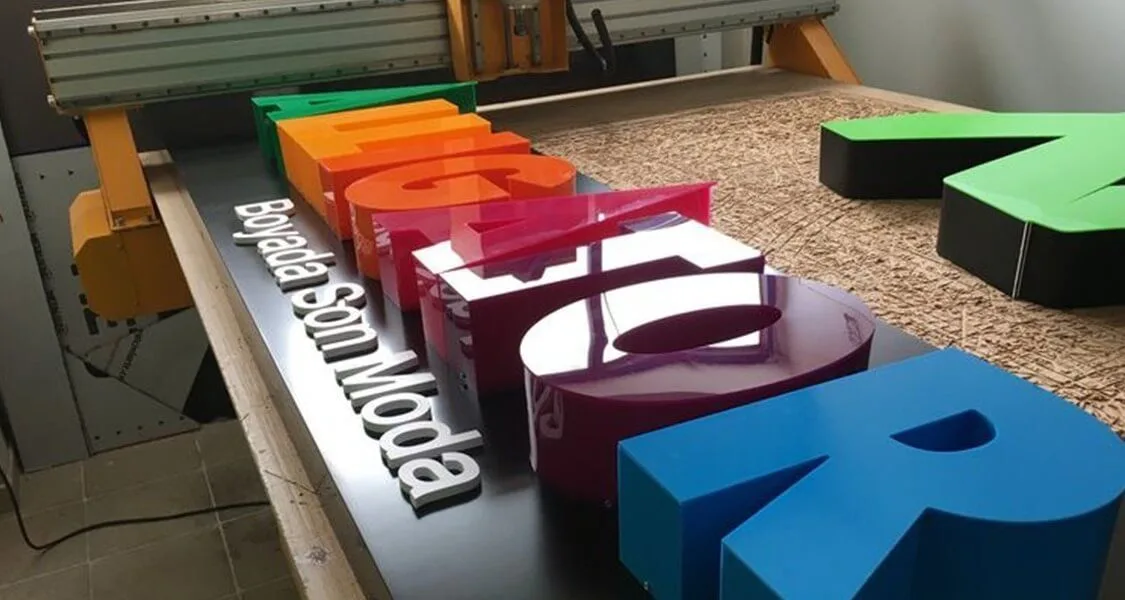
CNC-cut acrylic sign parts on the router bed at the Bayan Signage factory
CNC-cut acrylic parts on the router bed
Stainless steel sign components on the fabrication bench in Ajman
Stainless steel work on the fabrication bench
Expert advice

Advice from our estimating team

These are the points we raise on almost every reflective road sign enquiry. Each one is cheap to settle on paper and expensive to fix once the posts are in the ground.

Pick the sheeting grade by road speed

As a working rule, high intensity prismatic suits internal roads up to about 60 km/h, and full-cube microprismatic earns its extra cost on faster roads, overhead panels and junctions where several decisions come close together. Engineering grade glass-bead sheeting is fine for a car park or a short-term use, but it returns a fraction of the light and fades sooner in UAE sun. Where an authority or consultant names a grade, that decision is already made for you.

Keep one grade along a route

Drivers read brightness as importance. If a new microprismatic sign stands beside a tired engineering grade sign, the new one shouts and the old one disappears, even when the old one carries the more important message. When a community replaces signs in phases, we suggest doing a whole route or zone at once so the picture at night stays consistent.

Turn the face a few degrees away

A sign mounted exactly square to oncoming traffic can mirror headlamp glare straight back and wash out the legend. Turning it roughly 3 to 5 degrees away from the carriageway avoids the problem without losing brightness. It is one line on the setting-out drawing, and it is one of the faults we find most often when we survey existing signs.

Size from speed and reading distance

On slow internal roads at 20 to 40 km/h, a 600 mm regulatory sign is usually enough; at 60 to 80 km/h we move up to 750 or 900 mm. For text signs, allow about 25 mm of letter height for every 10 m of reading distance. Arabic and English are sized as one composition, so neither script is squeezed into the space the other left over.

Judge the sign at night, not at noon

Every reflective sign looks fine at midday. The real test is a car on dipped headlamps at the distance a driver needs to react. We inspect new installations after dark before handover, and we suggest owners do a night drive once a year, because reflectivity fades before colour does and a sign can look new by day while barely working at night.

Pricing

Reflective road sign price in Dubai: what affects the cost

Every set is priced from its sign schedule, so there is no fixed price list. Send us the layout or a list of signs, sizes and locations, with any specification, and we will return an itemised quotation, usually within 24 hours, that separates fabrication, posts, installation and approvals.

Sheeting grade

Engineering grade is the most economical, high intensity prismatic costs more, and full-cube microprismatic more again. Brighter grades usually last longer, which narrows the gap over the life of the sign.

Sign size and variety

Standard regulatory shapes in quantity are efficient to produce. Many one-off information signs, each with its own Arabic and English text, take more layout and proofing time.

Posts and foundations

Post diameter, height and footing size grow with sign area and wind load. Base plates onto an existing slab can save excavation where the slab is strong enough.

Site conditions

Live roads need traffic management and sometimes night work. Scanning for buried cables and pipes before excavation is standard practice and affects the programme.

Coastal or sandy exposure

Stainless fixings, isolating washers and powder-coated posts add a little cost but prevent staining and corrosion on seafront and desert-edge roads.

Specification and submittals

Jobs built to an authority or consultant specification need material submittals, samples and inspections, which add time and paperwork compared with a purely private set.

Approvals

Reflective road signs and approvals in the UAE

Official signs on public roads follow the road authority's specification: RTA in Dubai, and the relevant transport authority or municipality in Sharjah, Ajman, Abu Dhabi and the northern emirates. Those signs are normally delivered through approved contractors on a road project. Inside master communities, free zones and private plots, the developer or free-zone authority usually sets the rules, although a sign where a private road meets a public one may still need the public format.

Our technical draftsmen prepare the sign schedules, layout drawings and material submittals that consultants and developers ask for, and we supply sheeting samples for approval before production. We also check the Arabic and English wording against the approved names. Requirements differ between communities and authorities, so we confirm what applies to your exact site at the survey stage.

Why Bayan Signage

Why businesses choose Bayan Signage for reflective road signs

Made in our own factory

CNC cutting, sheeting lamination, post welding and finishing all happen at our Ajman factory, so plates, legends and posts are controlled by one team. You are welcome to visit during production.

Built to your specification

Our draftsmen work from the consultant's or developer's specification and submit drawings and sheeting samples for approval before a single sign is cut.

5-year outdoor warranty

Permanent outdoor road signs are covered for 5 years on structure and powder coat, with a warranty document issued at handover.

Installation in all seven emirates

Our crews install across the UAE from Ajman, foundations included, and the site survey is free in Dubai, Sharjah and Ajman.

Itemised quotes in 24 hours

Fabrication, posts, installation and approvals are priced as separate lines, usually within 24 hours, so you can compare offers like for like.

500+ clients across the UAE

Developers, contractors, national retail groups and international brands come back to us for new phases, and most of our work arrives through repeat clients and referrals.

FAQ

Reflective Road Signs questions we are asked most

How much do reflective road signs cost in Dubai?

The cost depends on the sheeting grade, sign size, quantity, posts and foundations, and whether the work is on a live road. A set of standard regulatory signs in high intensity sheeting costs far less per sign than bespoke bilingual information panels on large posts. Send us the sign schedule or a site plan and we will send an itemised quote, usually within 24 hours.

Which reflective sheeting grade do I need?

It depends on road speed, junction complexity and any specification that applies. High intensity prismatic suits most community and industrial roads, while full-cube microprismatic is usual for faster roads, overhead signs and busy junctions. On public roads the authority sets the grade, and we confirm the current requirement for your site before production.

Can you supply reflective road signs for public roads?

Signs on public roads follow the road authority's specification and are usually delivered through approved contractors as part of a road project. We fabricate reflective road signs to the specification provided for contractors, master communities, free zones and private roads, and we check with the client or consultant that materials and format meet the current requirement.

How long do reflective road signs last?

High intensity and microprismatic signs typically perform for seven to ten years or more, while engineering grade fades sooner. In the UAE, sun-facing reds and signs near open sand or the sea age fastest. Our permanent outdoor signs carry a 5-year warranty on structure and powder coat, and a yearly night check shows when a face needs replacing.

What is the difference between reflective and illuminated road signs?

A reflective sign needs no power: its sheeting returns headlamp light to the driver. An illuminated sign has its own light source and a supply to maintain. On most community and industrial roads, good prismatic sheeting is brighter in headlights than people expect, and it avoids cabling and lamp failures. Lighting is usually kept for unlit roads with complex junctions where a specification calls for it.

Do you make reflective road signs in Arabic and English?

Yes. Information and direction signs are normally bilingual, and we design both scripts together so each reads at the same distance. Regulatory signs rely on standard symbols with short text where the format requires it. We check every name against the approved spelling list, so the road signs agree with the street name signs and the community map.

Do you install road signs outside Dubai?

Yes. Our crews install across Dubai, Sharjah, Ajman, Abu Dhabi, Ras Al Khaimah, Umm Al Quwain and Fujairah, including foundations and posts. The site survey is free in Dubai, Sharjah and Ajman, and we can work night shifts where a road cannot close during the day.

Can faded or damaged reflective road signs be replaced one at a time?

Yes. Each sign is a separate plate on its own fixings, so a struck post or a faded face can be replaced without touching the rest of the set. We keep the artwork for the signs we make, so a replacement matches its neighbours in size, lettering and sheeting grade.

Free quote

Get a quote for reflective road signs

Send your logo, the fascia size and a site photo. Our estimating team replies with options and an itemised price, usually within 24 hours.

  • Call or WhatsApp +971 56 637 2656
  • Workshop: Alam Square, Industrial Area 2, Ajman
  • Sunday to Thursday, 08:00 to 18:00