Electrical warning signs · Made in Ajman

High Voltage Signs in Dubai, Sharjah & Abu Dhabi

Bayan Signage makes high voltage signs, electrical room door signs and equipment warning labels in its own Ajman factory, for building owners, MEP contractors and facility managers across the UAE. We work from your equipment schedule, print every reference exactly as it appears on the drawings and choose materials that survive hot plant rooms and sun-baked enclosures.

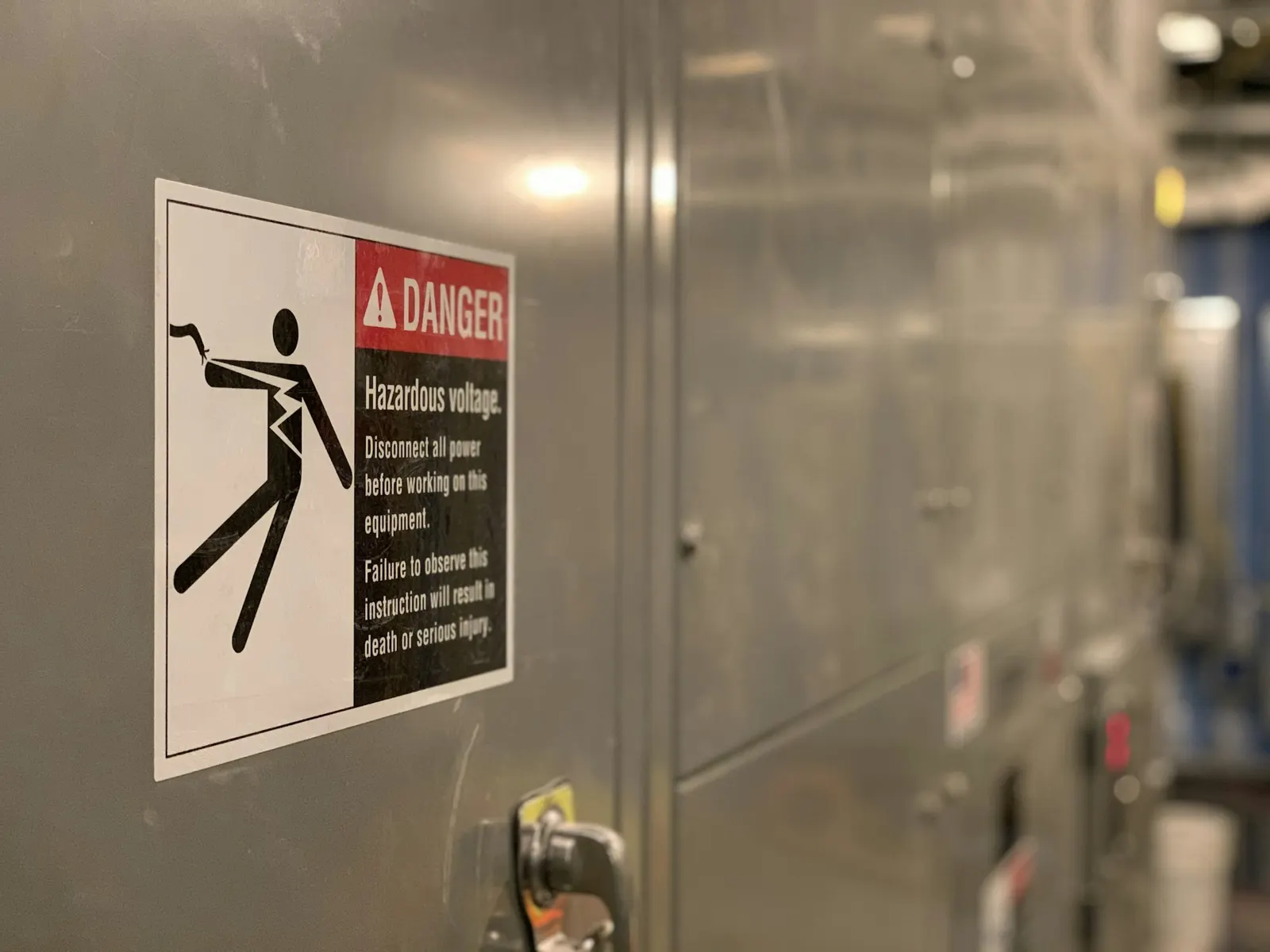
Danger hazardous voltage warning sign fixed to grey electrical switchgear cabinets
Illustrative photo · Unsplash
2016Factory established in Ajman
500+Clients across the UAE
In-houseDesign, fabrication and installation
24 hTypical quote turnaround
Prepared by Bayan Signage production & estimating teamFactory: Alam Square, Industrial Area 2, AjmanUpdated
Electrical & High-Voltage Signs in the UAE

High voltage signs for every layer of an electrical system

A high voltage sign warns people about a hazard they cannot see, hear or smell: the ISO 7010 yellow triangle with a black lightning arrow, usually with 'Danger: high voltage' or 'Authorised persons only' in Arabic and English. These signs belong on substation and switch room doors, transformer compounds, generator rooms, main distribution boards, solar inverters and EV charger cabinets. Our clients are mostly MEP contractors closing out a handover, facility managers preparing for an audit and developers fitting out a new community.

Good electrical signage works in layers, and most problems come from mixing them up. The outer layer stops the public with a large, simple warning on fences and doors. The next tells trained staff which room or panel they are at, and at what voltage. The innermost layer is the label on the equipment itself. Each has a different reader, a different size and a different material. We plan all three from one schedule in our Ajman factory, so the reference on the door matches the reference on the panel inside.

Bayan Signage has fabricated signs at Alam Square, Industrial Area 2, Ajman since 2016, as the production arm of Bayan Advertising, which has 15 years in the UAE market. Our printing, laminating, CNC routing and assembly are all in-house, and our project managers are used to working under permits to work, site inductions and escorted access. The crew that prints your labels is the crew that fixes them, which is how references stay correct from the spreadsheet to the switchgear.

Trusted by 500+ UAE businesses, including

Al-Futtaim logoAl Ghurair logoMultiply Group logoAriston Group logoCARS24 logoDouble A logo
Our process

How we produce high voltage signs in our Ajman factory

  1. Schedule from your drawings

    We take the equipment list or single line diagram from your electrical contractor as a spreadsheet, and turn each row into a sign or label with its location, wording, size and material agreed.

  2. Operator standard check

    Where a utility, master developer or facilities manager has its own template for substations or plant rooms, we match it exactly and send proofs for approval before printing.

  3. Print and laminate

    Warnings are printed on 3M cast vinyl with UV-resistant inks and laminated, so the yellow holds its colour and dust wipes off without scrubbing the print away.

  4. Cut, mount and label

    Aluminium and rigid substrates are CNC-routed to ±0.1 mm with fixing holes in place. Each finished sign is marked on the back with its schedule reference.

  5. Quality check by reference

    Before dispatch we check every item against the approved schedule: wording, voltage, equipment number and quantity. One swapped digit on a feeder label is a safety problem, not a typo.

  6. Installation under site rules

    We install with the authorised person on site, under the permit to work, fixing only to safe or isolated surfaces, and record each sign location against the equipment list for handover.

Specification

High voltage sign specification

This is the specification we start from for building and site electrical signage. We adjust it to the operator's standard and the temperature at each location, and list every change on the quote.

ItemOur standardUpgrade optionsWhy it matters
Door sign substrate2 mm aluminium3 mm ACP for larger panelsRigid, flat and unaffected by plant room heat; does not crack when a door slams.
Fence panel substrateRigid PVC or polycarbonateAluminium where the engineer approvesSome operators prefer non-metallic signs near exposed conductors.
Print3M cast vinyl, UV-resistant inksReflective film for unlit compoundsYellow fades faster than black; quality inks keep the warning strong.
Face protectionGloss UV laminateAnti-graffiti laminateA smooth face sheds dust and cleans with a damp cloth.
Equipment labelsHeat-rated label film and adhesiveRigid labels with rivets or screwsCabinets in sun run far hotter than the air; ordinary adhesive slides off.
FixingsRivets, high-bond tape or stainless tiesTamper-resistant fixingsSigns must not swing, peel or be easily removed from live equipment.
Our work

Inside our Ajman factory

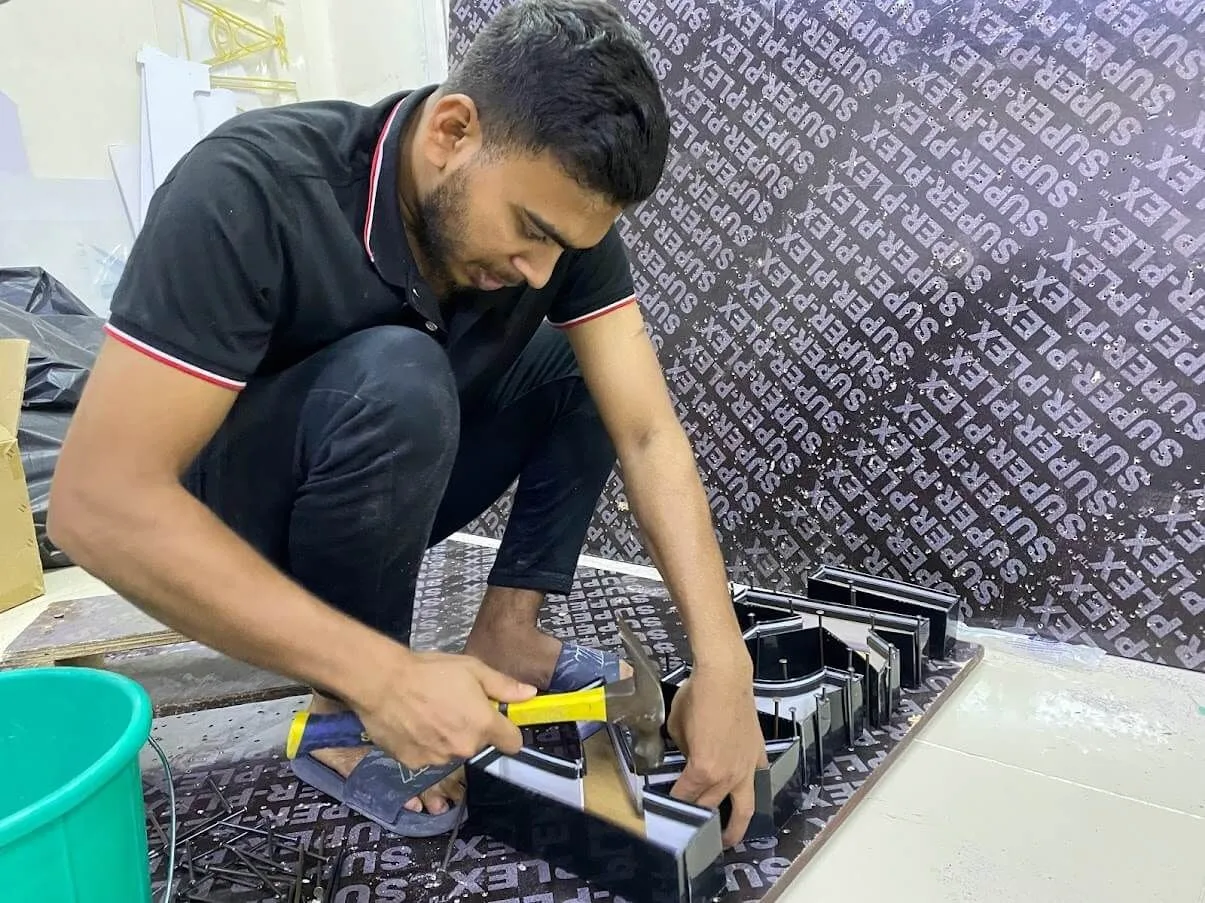
Bayan Signage technician assembling a sign in the Ajman workshop
Assembly in our Ajman workshop
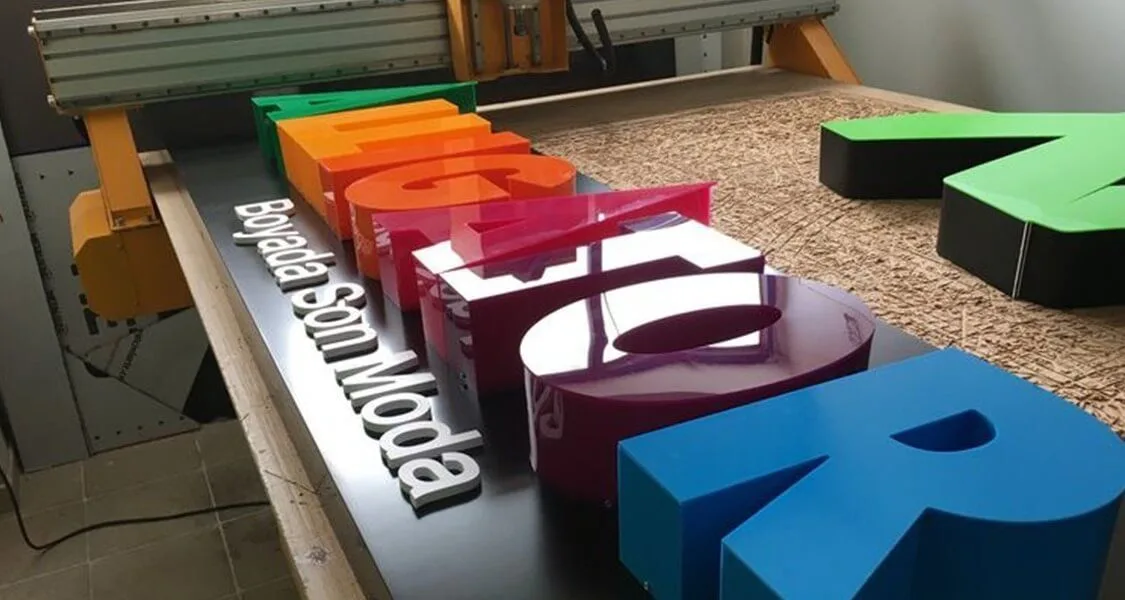
CNC-cut acrylic sign parts on the router bed at the Bayan Signage factory
CNC-cut acrylic parts on the router bed
Stainless steel sign components on the fabrication bench in Ajman
Stainless steel work on the fabrication bench
Expert advice

Advice from our technical draftsmen

Electrical signage is mostly about information control. These are the points our draftsmen raise before we print a single label.

Send a spreadsheet, not an email list

Ask your electrical contractor to export the equipment schedule and send it to us as a spreadsheet. Each row becomes a label, and the references match the single line diagram exactly. Retyped references are where mistakes creep in: one wrong digit on a feeder label can send a technician to isolate the wrong board. We return the schedule with a sign code added to every row, so later replacements are a reprint, not a guess.

Fix the sign to the door leaf

A sign on the wall beside an electrical room, or above the frame, disappears the moment the door swings open, and the person walking in never sees it. Fix it to the leaf at eye level, around 1.5 m to its centre, and never through the door's fire seal, glazing or any electrical component. On double doors, sign the leaf that is used daily.

Plan for 70°C inside cabinets

Inverters, MDB cabinets and rooftop enclosures in direct sun can run well above 70°C inside during summer. Standard sticker adhesive softens, and labels slide or curl within a season. For these locations we use heat-rated label film and adhesive, or a rigid label with mechanical fixings, and keep text at least 5 mm high so it reads by torchlight.

Repeat fence signs on every approach

A transformer compound signed only at the gate is unsigned from three sides. We recommend a panel on every face of the fence, near every gate, and at intervals of roughly 10 m on long runs, tied at top and bottom. Check fence signs after strong wind: a missing panel is exactly where someone will climb.

A sign is not a lock

We are asked surprisingly often whether a warning sign is enough on an electrical room that nobody locks, which is then used as a cleaning store. It is not. Doors to live equipment need locks and access control; the high voltage sign explains why the door is locked. Pair it with an 'Authorised persons only' line so the message is clear.

Pricing

High voltage sign price in Dubai: what affects the cost

We quote from your sign schedule, not a price list. Send the equipment list, any operator template and a few site photos, and you will usually have an itemised quote, with materials, labour and installation separated, within 24 hours.

Mix of signs and labels

A few door signs cost little. Hundreds of individual equipment labels, each with its own reference, need artwork and checking time and usually drive most of the cost.

Material choice

Laminated rigid PVC is economical; aluminium and polycarbonate cost more, and heat-rated labels with mechanical fixings cost more again but stay put.

Operator templates

Matching a utility or developer template exactly adds proofing time, but avoids rejection at handover and a second production run.

Variable data quality

A clean spreadsheet is fast to produce. References typed from drawings, or missing data, add drafting time before anything can be printed.

Access and permits to work

Fixing inside live switch rooms, on rooftops or in substations usually needs escorts, permits and set time slots, which affect installation cost.

Number of sites

Several plant rooms in one tower are efficient. Substations spread across a community add travel and coordination for each location.

Approvals

High voltage sign standards and handover checks

Electrical warning signs are not usually something you apply for, but they are checked. Building handovers, Civil Defence inspections and facility audits commonly look for electricity warnings and 'Authorised persons only' signs on electrical rooms and risers. We follow ISO 7010 for the warning symbol and normally set all text in Arabic and English, which is what most UAE inspectors and operators expect.

Substations and network equipment are often subject to the electricity utility's or master developer's own signage standard, which may set wording, colours, size and position. Where that applies, we work to the operator's current template and confirm it before production, because generic signs are sometimes rejected and have to be replaced. Requirements vary by site and operator, so we check them for your project.

Why Bayan Signage

Why contractors choose Bayan Signage for high voltage signs

References printed from your data

Labels are generated from your spreadsheet and checked line by line, so every reference matches the drawings and the maintenance team can trust it.

Materials chosen for heat

We specify substrates, inks and adhesives for each location, from cool risers to sun-baked rooftop cabinets, rather than one sticker for everything.

Comfortable on live sites

Our crews work under permits to work, inductions and escorted access, and install only where the authorised person on site directs.

All in-house in Ajman

Printing, laminating, CNC cutting and assembly happen in our own factory, so large label runs stay consistent and urgent replacements are quick.

Draftsmen who read MEP drawings

Our technical draftsmen work from single line diagrams and equipment schedules, and flag gaps or conflicts before production rather than on site.

One contact for the safety set

Electrical, fire, exit, PPE and chemical signs can be produced in one matched set, with a single project manager from schedule to handover.

FAQ

Electrical & High-Voltage Signs questions we are asked most

What colour is a high voltage sign?

Under ISO 7010 the electricity warning is a yellow triangle with a black border and a black lightning arrow, and the supporting text is usually black on yellow or white. Some utilities and operators add a red 'Danger' header on high voltage installations, so the text panel can follow the operator's own standard. We confirm which applies before printing.

Do electrical room doors need a high voltage sign?

In most buildings, yes. Electrical rooms, switch rooms and risers are normally expected to carry an electricity warning and an 'Authorised persons only' message so untrained people do not enter. Building management, Civil Defence inspections and contractors often check for them at handover. The exact wording may depend on the voltage and the operator's standard.

Should signs near high voltage equipment be metal?

Not always. Aluminium is durable and common on doors, but on fences or close to exposed conductors some operators prefer non-metallic signs in rigid PVC or polycarbonate. The choice should follow the electrical engineer's or operator's requirement for the site, and we produce whichever material they specify, with fixings to suit.

Can you print equipment numbers on each label?

Yes. We produce sets of labels with individual references, voltages and feeder numbers directly from a spreadsheet, so every label is unique and matches the electrical drawings. This is common for distribution boards, switchgear and generator rooms, and it is far more reliable than writing references onto blank labels on site.

What labels does a solar PV system need?

Typically warnings on inverters, combiner boxes, DC isolators and cable routes stating that the system can remain live in daylight, plus a sign at the main switchboard showing a PV system is connected. The exact set depends on the installer's design and the authority's current requirements, so we work from the installer's labelling schedule.

How long do high voltage signs last outdoors?

Laminated aluminium signs usually last many years outdoors in the UAE, though yellow fades faster than black and the warning can look washed out after several summers. Equipment labels in hot cabinets have a shorter life unless they are heat-rated or mechanically fixed. Replace any sign that has faded noticeably, because a pale warning is easier to ignore.

How much do electrical hazard signs cost in Dubai?

The cost depends mainly on how many unique labels you need, the materials and the access on site. A handful of door signs is a small order; a full schedule of equipment labels for a tower is a larger drafting job. Send us the equipment list and photos, and we will send an itemised quote, usually within 24 hours.

Can you replace faded or missing electrical signs?

Yes. We survey the existing signs, list what is missing, faded or wrong, and produce replacements that match the current equipment references. Where equipment has been renumbered or replaced since the original handover, we update the labels at the same time, so doors, panels and drawings all agree again.

Free quote

Get a quote for electrical & high-voltage signs

Send your logo, the fascia size and a site photo. Our estimating team replies with options and an itemised price, usually within 24 hours.

  • Call or WhatsApp +971 56 637 2656
  • Workshop: Alam Square, Industrial Area 2, Ajman
  • Sunday to Thursday, 08:00 to 18:00