Key takeaways
- Treat office branding in Dubai as a fit-out trade. Graphics go onto paint, partition glass and facade glazing that someone else built, so most failures are specification failures, not printing failures.
- Choose wall graphics by three questions: how long they stay, what the wall is, and whether they must come off cleanly at lease end. Removable printed vinyl with a matte laminate suits most leased offices.
- Fresh paint is the number one cause of lifting wall graphics. Allow at least two weeks of cure (longer for dark or washable paints) and test a patch on the real wall before a large run.
- Glass stickers do three jobs: privacy (a frosted band of roughly 900 to 1,700 mm), safety manifestation (zones at 850 to 1,000 mm and 1,400 to 1,600 mm) and branding. A repeated logo in the manifestation zones does two jobs at once.
- On sun-facing facade glass, dark or partial films can crack the pane from thermal stress. Identify the glass and get the film maker's written compatibility first. Branded graphics visible from a street may need an advertising permit under Dubai Decree No. 6 of 2020.
Office branding is a fit-out trade, not decoration
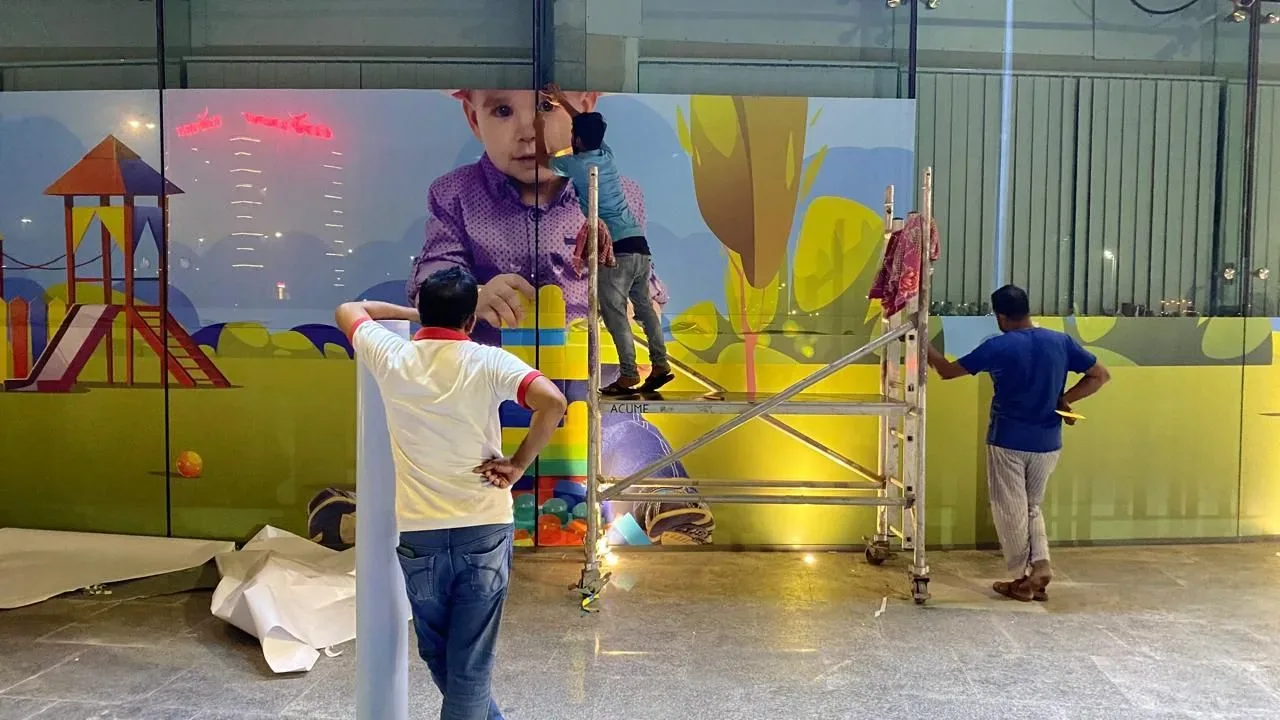
Most office branding problems in Dubai do not show up on handover day. They show up three weeks later, when a wall graphic lifts at the edges because the paint had not cured. Or when a double-glazed meeting room panel cracks after a dark film went on in August. Or at the end of a lease, when the graphics come off and take the paint with them, and the landlord deducts reinstatement from the deposit.
Each of those is a specification failure, not a printing failure. Office graphics are applied to surfaces the branding contractor did not build: fresh paint, partition glass, facade glazing and timber. They have to fit the fit-out programme, the fire strategy, the landlord's lease terms and, for anything facing the street, the advertising rules.
This guide is for facilities managers, fit-out project managers, interior designers, office managers and marketing teams who brief, approve or install office branding in Dubai and the wider UAE. It covers the typical items by zone, how to choose wall graphic media and prepare walls, glass stickers and manifestation, fire ratings and approvals, design rules, and the installation and removal sequence.
Office branding items, zone by zone
An office branding schedule is easiest to brief, price and check when it is organised by zone, with the surface named for every item.
| Zone | Typical items | Surface and the main risk |
|---|---|---|
| Entrance and corridor door | Company name on the glass door or side panel, opening hours, unit number, push and pull markers | Glass or timber door in a landlord-controlled corridor; the building may set a standard tenant format |
| Reception | Logo wall (3D letters, acrylic or metal), printed feature wall, reception counter graphic, screen surround | Painted wall or cladding; letters need fixings or backing in the right place before the wall is closed |
| Open-plan workspace | Feature wall graphics, values or timeline walls, team or zone naming, column wraps, printed acoustic panels | Painted plasterboard; long runs show every seam and every bump in the wall |
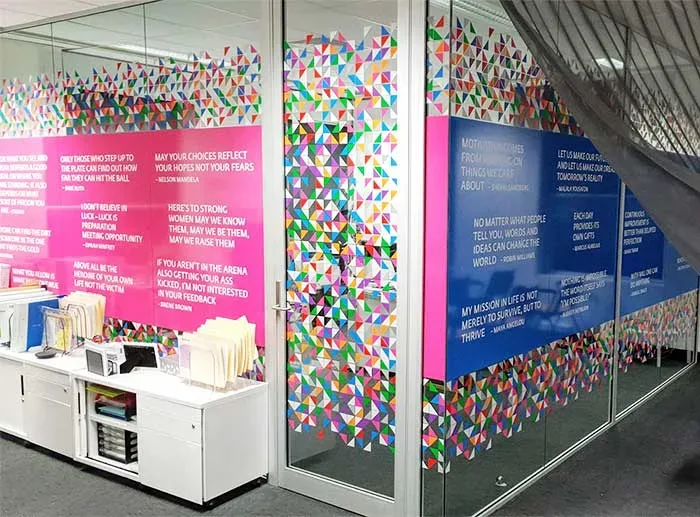
| Meeting rooms | Frosted privacy bands, room names on glass, manifestation, booking screens | Partition glass, sometimes double-glazed or acoustic laminated |
| Corridors and wayfinding | Floor and department directories, directional signs, room numbers | Mixed surfaces; must stay consistent with the building's statutory signage |
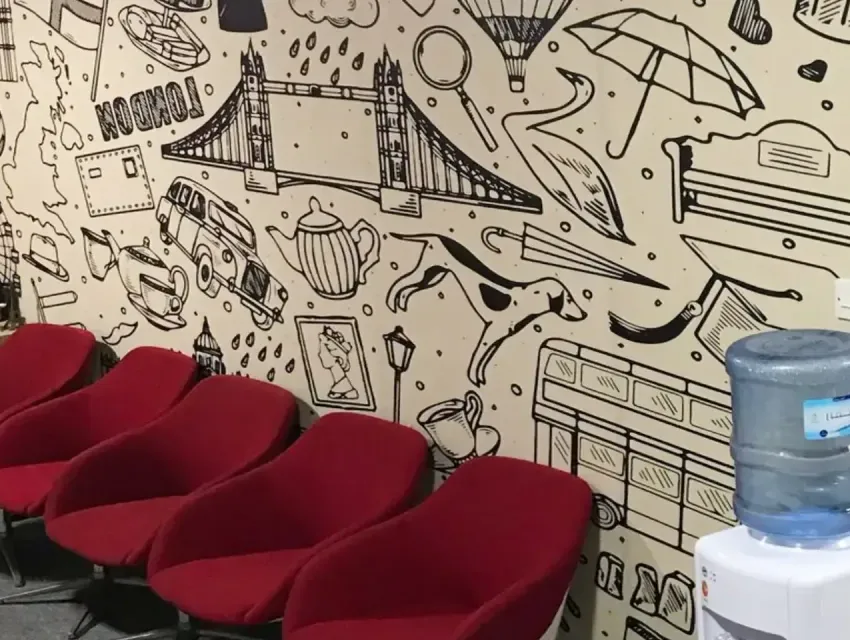
| Pantry and breakout | Wall murals, menu or notice graphics, washable panels | Walls near sinks and coffee machines take splash, steam and cleaning chemicals |
| Exterior glazing | Window privacy film, logo graphics visible from the street or mall, perforated window film | Facade glass with thermal stress risk; may count as advertising and need a permit |
| Statutory and safety | Fire evacuation plans, exit and fire equipment signs, first aid, no-smoking | Governed by the fire code and building management, not the brand guide |
Two points help at briefing stage. First, list the substrate and its finish for each item (emulsion paint, glass type, timber veneer or ACP), because media choice depends on it. Second, separate items the tenant owns from items in landlord areas, such as corridor doors, shared lobbies and the facade, which usually need building management approval.
For the individual products behind this table, see office wall branding, reception logo signs, meeting room signs, glass door branding and evacuation plan boards.
Wall graphics in Dubai: choosing the media and preparing the wall
The right medium for wall graphics in Dubai offices depends on three questions: how long the graphic stays, what the wall is, and whether it must come off cleanly. Get those answers before choosing a look.
| Medium | Best for | Watch out for |
|---|---|---|
| Removable or low-tack printed wall vinyl, matte laminate | Feature walls in leased offices, campaigns, walls that may change in one to three years | Lower grip on matte or washable paints; needs a smooth wall |
| Permanent cast or calendered printed vinyl | Long-term graphics on stable surfaces, column wraps, doors | May pull paint on removal; cast film conforms better over curves and edges |
| Textured-wall films (heat-applied) | Blockwork, rough render, light texture where standard vinyl would tent | Slower to install; needs a trained installer and heat-gun technique |
| Printed wallpaper (non-woven or vinyl-coated) | Large murals, full-wall coverage, hotel-style finish in offices | Applied with paste; check the product's fire certificate |
| Cut vinyl lettering and wall decals | Values statements, room names, simple marks on painted walls | Small letters on rough walls lift; very thin strokes are hard to weed and apply |
| Fabric SEG lightboxes and printed acoustic panels | Feature walls that need light, and open-plan zones with echo problems | Frame depth, power and fixings must be planned; check the fabric's fire certificate |
| 3D letters (acrylic, PVC foam, metal) | Reception logos, name walls | Need backing or fixing points in the wall; studs and wiring must be located |
The paint-cure problem
Fresh paint is the most common cause of failed wall graphics in new fit-outs. Emulsion paint can feel dry within hours but keeps releasing solvents and moisture for weeks. Self-adhesive vinyl applied too early traps them, and the result is bubbles, softening and edges that lift. Film makers ask for fully cured paint. Installer guidance gives two weeks as the recommended wait, and many paint makers quote about 30 days for a full cure. On a compressed Dubai fit-out programme, that wait rarely exists. So either paint the graphic walls first, or choose printed wallpaper or a framed system for walls painted late.
Paint chemistry and the test patch
Scrubbable, washable and anti-stain paints often leave a low-energy surface that adhesives struggle to grip. Wall film makers such as General Formulations require a test patch on washable or scrubbable paints. Apply the actual film to the actual wall, check it after 15 minutes and 24 hours, then peel it. If it lifts on the patch, it will lift on the wall. If it pulls paint on the patch, it will pull paint at lease end.
Wall finish
Large printed graphics show every flaw under office lighting, especially light raking from the side. Ask the fit-out contractor for a smooth, sanded finish on graphic walls and agree it in writing, because a wall that is fine for paint is often not fine for vinyl.
Glass stickers in Dubai offices: privacy, manifestation and thermal stress
Glass stickers and films do three different jobs: privacy, safety marking and branding. Specify each one deliberately, because the film, the height and the risks differ.
Privacy films
Frosted glass film is the standard for meeting rooms and private offices. Plan the privacy band around seated and standing eye heights: a band from roughly 900 to 1,700 mm above the floor blocks the view of people seated at a table while keeping daylight above and below. Graduated or patterned frosts give partial privacy and look lighter on long partitions. Sandblast-effect film gives the look of treated glass and can be replaced when the layout changes. Printed or coloured films carry brand colour but also tint the light in the room, so test a sample against the actual lighting. For exterior windows, see privacy window film and one-way vision film.
Manifestation (safety marking)
Full-height glass partitions and doors need visible markings so people do not walk into them. The UAE does not have one widely published local manifestation rule, so Dubai fit-outs commonly follow British practice. Under BS 8300, recognised by UK Building Regulations, manifestation sits in two zones: 850 to 1,000 mm and 1,400 to 1,600 mm above the floor, contrasting with what is seen through the glass in all lighting. Under UK guidance it can be a logo or sign at least 150 mm high, or a decorative band or broken line at least 50 mm high. The European standard EN 17210 asks for a little more: bands of at least 75 mm at 900 to 1,000 mm and 1,500 to 1,600 mm, plus a third marking low down.
This is the useful point for branding: manifestation can be the brand. A repeated logo, pattern or wordmark in the two zones meets the safety need and looks intentional rather than added. See glass manifestation graphics for typical band sizes and dot patterns.
| Glass sticker job | Typical height | Film options |
|---|---|---|
| Privacy band | About 900 to 1,700 mm from finished floor | Frosted, sandblast-effect, gradient or patterned film |
| Manifestation | 850 to 1,000 mm and 1,400 to 1,600 mm (BS 8300) | Frosted or coloured bands, dots, repeated logo |
| Door and room names | Around eye level, about 1,400 to 1,600 mm | Cut vinyl, printed vinyl, frosted with clear lettering |
| Facade branding | Set by the view from the street and the permit | Perforated window film, cut vinyl, printed vinyl |
Thermal stress on sun-facing glass
This matters most on exterior windows and on internal partitions that catch direct sun. Filmed glass absorbs more heat than the edges held cool in the frame. If the temperature difference is large enough, the glass can crack from the edge. The risk is highest with dark or highly absorbent films, with partial coverage (a hot zone beside a cool zone), and on annealed, tinted or double-glazed units. Glass makers such as Pilkington advise reviewing field-applied films for thermal stress with the film supplier and getting recommendations in writing. Film makers such as 3M run a glass checklist before they cover glass breakage under warranty, and exclude partial applications. With Dubai's solar load, that check is not optional for facade glass.
Practical rules for sun-facing glass:
- Identify the glass first: annealed, heat-treated, laminated, tinted, single or double glazed. The facade documents or the mark in the corner of the pane usually tell you.
- Prefer light, low-absorption films and perforated window films for street-facing graphics; avoid solid dark graphics covering part of a pane.
- Get the film maker's compatibility confirmation for the specific glass, especially for double-glazed facade units, where a cracked unit can also void the glazing warranty.
- Never apply film to glass that is already chipped or cracked.
Fire ratings, approvals and landlord rules
Office graphics are interior finishes, and in Dubai interior finishes sit inside the fit-out approval and the fire strategy. Small decals rarely raise questions; full-wall coverings, fabric, foam letters and acoustic panels often do.
Fire performance
The UAE Fire and Life Safety Code, enforced by Civil Defence, controls interior finishes in escape routes and occupied spaces. Fit-out reviewers commonly ask for fire test certificates for wall coverings and decorative panels, typically to ASTM E84 or EN 13501-1. Under ASTM E84, a Class A interior finish has a flame spread index of 0 to 25 and a smoke developed index up to 450. A few principles from international codes help when specifying:
- Thin finishes applied directly to the wall, such as paint and thin wallpaper, are generally treated as part of the wall. NFPA 101, for example, exempts approved materials thinner than about 0.9 mm (1/28 inch) applied directly to walls and ceilings. Self-adhesive vinyl on plasterboard usually sits in this category, but keep the film's certificate on file anyway.
- Coverage counts. The same code treats posters and similar items as interior finish once they cover more than 20 percent of the wall. Full-wall graphics in corridors and exit routes deserve a certificate.
- Foam plastics are restricted as interior finish under international building codes. Large PVC foam or polystyrene letters in escape routes should be checked with the fire consultant, with acrylic or metal used instead where needed.
- Fabric and acoustic panels need their own certificate, tested as installed, including any adhesive or frame.
Approvals and landlords
Office fit-outs in Dubai go through the landlord or building management NOC and the authority for the area, such as Dubai Municipality, DDA, Trakhees or DMCC. Graphics are usually covered by the fit-out drawings if they are shown on them, so include wall graphics, 3D logos and glass films in the drawing set rather than adding them after approval. Corridor doors and shared lobbies often follow a building-wide tenant standard; office name signs for those doors should be drawn to it.
Graphics seen from outside
Logos and messages on windows facing a street, a mall concourse or a public area can count as advertising. Under Decree No. 6 of 2020, displaying an advertisement in Dubai needs a permit from the competent authority. Check with building management and the authority before putting promotional graphics on external glass, and keep plain privacy frosting separate from branded messaging. Our window graphics page covers the street-facing options.
Design rules for office wall graphics and glass branding
Office graphics are seen every day by the same people, so they have to wear well rather than shout. These rules separate a branded office from a wall of logos.
- Design to measured walls, not drawings. Columns, sockets, switches, AC grilles, fire alarm call points and access control readers all sit on walls. Survey after first fix and design around them. Never print over a call point, extinguisher sign or fire alarm device.
- Plan panel joins. Printed vinyl and wallpaper come in rolls usually 1.0 to 1.5 m wide. Put joins on plain background, never through faces, text or a logo. Overlap joins for vinyl, butt joins for wallpaper.
- Resolution at viewing distance. For walls seen from 1 to 3 m, supply artwork at about 100 to 150 dpi at full size. Low-resolution stock photos enlarged to wall size look soft from the desk.
- Matte for walls. Gloss laminate reflects windows and ceiling lights and makes text hard to read from an angle. Use matte or satin laminate on most office walls.
- One idea per wall. A reception wall carries the logo. A values wall carries the values. Mixing logo, slogan, photos and statistics on one wall dilutes all of them.
- Bilingual where it matters. Reception and public-facing graphics in Dubai usually work best in Arabic and English, set by a native Arabic typesetter. Internal culture walls can follow the company's working language.
- Brand colour on glass. Brand colours behave differently on frosted film, coloured translucent film and opaque vinyl. Approve colour on a physical sample on the real glass, not on screen.
- Leave space for change. Team names, room names and campaign walls change. Put them on replaceable inserts, magnetic panels or low-tack films so updates do not mean redecorating.

Installation sequence, removal and reinstatement
Office graphics go on last and come off first, so the sequence with other trades decides the result.
- Survey after first fix. Measure walls and glass once partitions, sockets and AC grilles are in place. Record the glass type of every pane. A site survey at this stage is the cheapest way to avoid reprints.
- Design, sample and test. Issue scaled visuals on wall elevations. Run an adhesion test patch on the actual paint and approve physical samples of frosted film and brand colour.
- Paint the graphic walls early. Where self-adhesive vinyl is planned, paint those walls first so they have time to cure, or switch to wallpaper or framed systems on late walls.
- Clean glass and walls. Walls must be free of sanding dust. Glass is cleaned with a residue-free cleaner, never a silicone-based one that stops films bonding.
- Install after the dusty trades. Apply graphics after ceiling, flooring and electrical work, and before furniture blocks access. Apply glass film at stable room temperature with the AC running, not while the space is hot and unconditioned.
- Protect and snag. Check edges, seams and bubbles after 48 hours, once the adhesive has settled, and fix any lifting before handover.
Removal and reinstatement
Most Dubai office leases require the space to be returned to its original condition. Plan the exit at the start:
- Choose removable films on walls that must return to plain paint, and keep the product data sheet showing its removability period.
- Remove vinyl slowly with gentle heat, at a low angle, to release the adhesive rather than pull paint.
- On glass, remove film with a blade and clean off adhesive residue; never use abrasive pads on coated or low-E glass.
- Budget for spot repainting. Even a clean removal can leave a colour difference where graphics protected the paint from light.
A graphics package planned for removal costs far less at lease end than one that comes off with the paint.
How Bayan Signage handles office branding in Dubai
Bayan Signage designs, prints and installs office branding from its own factory at Alam Square, Industrial Area 2, Ajman, and has done so since 2016 as the production arm of Bayan Advertising. Wall graphics, printed wallpaper, frosted and printed glass films, cut vinyl, reception logos and 3D letters are produced in-house, and the same crews install them in Dubai and across all seven emirates. Because design, printing and installation sit under one roof, the person who measures the wall is part of the team that prints and fits the graphic.
If you are planning an office fit-out or a rebrand, see office wall branding, wall graphics and murals and corporate office signage, or send your floor plan, wall elevations or brand guide for an itemised quote, usually within 24 hours, through our quote form or on +971 56 637 2656. The site survey is free in Dubai, Sharjah and Ajman.
Frequently asked questions
What does office branding in Dubai usually include?
A typical package covers a reception logo wall, glass door branding, frosted privacy bands and manifestation on meeting room glass, feature wall graphics or murals in open-plan and breakout areas, room and department names, and wayfinding. Statutory fire and evacuation signs are scheduled separately because they follow the fire code, not the brand guide.
How soon can wall graphics go on a freshly painted wall?
Film makers ask for fully cured paint, commonly at least two weeks, and longer for dark, deep-tint or washable paints or cool, humid rooms. Applying earlier risks bubbles and lifting edges. Run a 24-hour test patch on the actual wall first.
Will office wall stickers damage the paint when removed?
Removable or low-tack films, removed slowly with gentle heat, usually come off cleanly. Permanent vinyl, poorly bonded paint or old graphics can pull paint, so plan for spot repainting at lease end.
At what height should glass manifestation be applied?
Common practice in Dubai follows BS 8300: two zones, 850 to 1,000 mm and 1,400 to 1,600 mm above the floor, contrasting with the background in all lighting. A logo or pattern in those zones can serve as both safety marking and branding.
Can frosted glass film crack office glass?
On internal partitions out of direct sun, the risk is very low. On sun-facing facade glass, especially double-glazed, tinted or annealed units, dark or partial films can cause thermal stress cracks. Check the glass type and film compatibility first.
Do office wall graphics need fire certificates in Dubai?
Thin self-adhesive vinyl on plasterboard rarely raises questions, but fit-out reviewers commonly ask for certificates for wallpaper, fabric, acoustic panels and large decorative features, especially in escape routes.
Do window graphics on an office need a permit in Dubai?
Plain privacy frosting usually does not. Branded or promotional graphics visible from a street or public area can count as advertising and may need a permit under Decree No. 6 of 2020, so check with building management and the authority.
Sources
- Time for some clear thinking on guidance for glass, PBC Today
- Manifestations key to a safety-first approach to glass, PBC Today, 2025
- Manifestation, Designing Buildings Wiki
- ATS-113: Field-applied plastic films and coatings on vision glass, Pilkington
- Glass checklist for window film, 3M
- Wall application guide, General Formulations
- Advanced wall graphics installation tips, Sign Warehouse
- Tips for newly painted walls, PRINTING United Alliance
- Interior finishes and furnishings guidance, Minnesota Department of Health, summarising NFPA 101
- Decree No. (6) of 2020 Regulating Advertisements in the Emirate of Dubai, Dubai Legislation Portal